
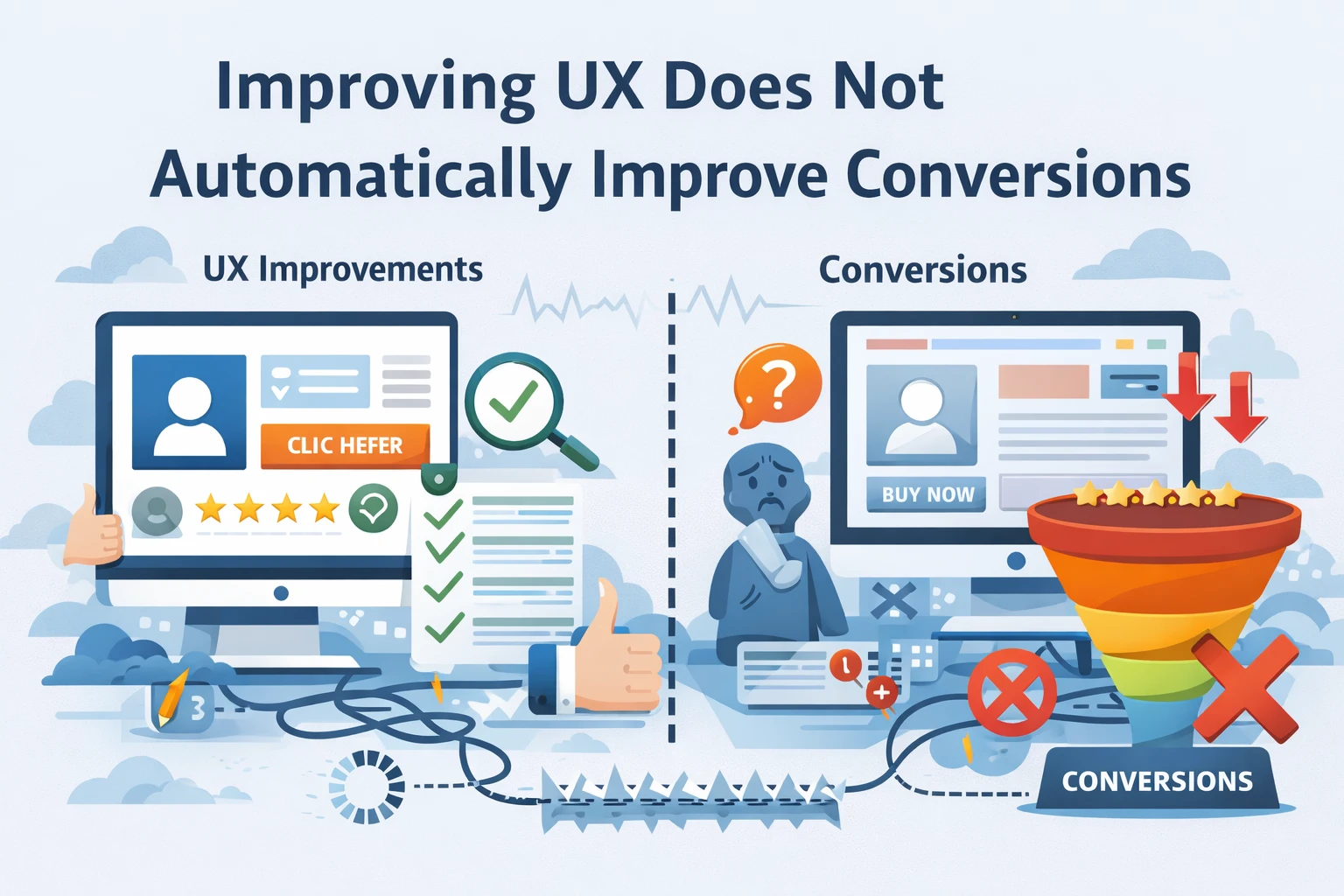
User experience is widely associated with better outcomes.
When conversions decline or growth stalls, UX adjustments often become the default intervention. Layout refinements, spacing changes, color updates, and interaction improvements appear to offer low-risk paths toward measurable gains. Because usability is visible and intuitive, teams frequently assume that improving interface quality directly improves business performance.
However, conversion behavior rarely responds so predictably.
At Wisegigs.eu, conversion investigations repeatedly reveal environments where UX improvements increase clarity yet fail to produce meaningful conversion uplift. Despite cleaner interfaces and smoother interactions, abandonment patterns, hesitation, and inconsistent user behavior often persist.
This outcome is structurally unsurprising.
Usability improvements modify interaction mechanics.
Conversions depend on decision mechanics.
UX Improvements Are Commonly Treated as Conversion Solutions
UX changes feel actionable.
They provide tangible artifacts: redesigned components, simplified layouts, faster interactions. These adjustments create an immediate perception of progress. Consequently, organizations often equate interface refinement with conversion optimization.
Yet conversions represent behavioral outcomes, not visual ones.
A page may become easier to navigate without becoming more persuasive.
A flow may become smoother without becoming more convincing.
Improved experience does not guarantee altered intent.
Usability and Conversion Are Distinct System Properties
Usability measures interaction efficiency.
Conversions measure decision outcomes.
These dimensions frequently correlate, but they are not causally identical. A system can exhibit excellent usability while performing poorly in conversion metrics. Likewise, high-converting systems sometimes retain noticeable friction.
The distinction matters.
Users completing tasks efficiently does not imply users choosing to act.
Interface quality alone does not determine commitment.
Behavior emerges from multiple psychological and contextual factors.
Google’s UX and performance guidance consistently separates usability from business outcomes:
Friction Reduction Does Not Guarantee Behavioral Change
Reducing friction removes obstacles.
It does not create motivation.
Users abandon pages for reasons unrelated to interface difficulty. Misaligned expectations, low trust, insufficient value clarity, and decision anxiety frequently dominate abandonment behavior.
Consequently, smoother flows may preserve existing patterns.
Visitors still hesitate.
Drop-offs still occur.
Conversion rates remain unchanged.
Absence of friction does not equal presence of intent.
Visual Clarity Can Still Produce Poor Decisions
Clean interfaces are not inherently persuasive.
Visual hierarchy improves comprehension. It does not guarantee conviction. Users may understand an offer perfectly while declining to engage.
Information clarity and decision confidence operate differently.
A well-structured page can still generate uncertainty.
An aesthetically refined layout can still fail to build trust.
Conversion barriers often exist outside visual structure.
Cognitive Load Dominates Conversion Behavior
Conversion events require decisions.
Decisions impose cognitive cost.
When users evaluate offers, compare alternatives, or assess risk, mental effort increases rapidly. Even highly usable interfaces cannot eliminate decision complexity.
Excessive choice, ambiguous value propositions, and unclear differentiation amplify cognitive load. As cognitive cost rises, deferral and abandonment become rational behaviors.
Nielsen Norman Group research frequently highlights decision complexity as a dominant UX constraint:
Conversion optimization therefore requires more than interface polish.
Trust Signals Frequently Outweigh Interface Refinements
Users evaluate credibility continuously.
Trust operates as a gating mechanism for conversions. Without sufficient confidence, even well-designed flows underperform. Visual improvements rarely compensate for weak trust signals.
Common trust constraints include:
Unclear business identity
Insufficient social proof
Ambiguous guarantees
Perceived risk exposure
These factors influence decisions more strongly than micro-level UI adjustments.
Usability cannot substitute for credibility.
A/B Testing Often Masks Deeper Issues
Testing frameworks encourage local experimentation.
Button colors, headline variations, and layout adjustments are easy to test. Structural issues are not. Consequently, many experiments operate at superficial layers while ignoring systemic constraints.
Small gains may appear statistically significant.
However, localized improvements rarely resolve foundational problems:
Weak value propositions
Audience mismatch
Trust deficiencies
Decision anxiety
Testing without diagnosis often optimizes noise rather than performance.
Industry experimentation literature frequently warns against misinterpreting test outcomes:
https://www.optimizely.com/optimization-glossary/ab-testing/
Why Local Optimizations Produce Inconsistent Results
Conversion systems behave contextually.
A modification improving performance for one audience segment may degrade performance for another. Traffic composition, intent variability, device constraints, and referral sources all influence outcomes.
Therefore, isolated UX changes generate unstable effects.
Short-term gains decay.
Results fail to generalize.
Performance fluctuates.
System-level constraints remain untouched.
What Reliable CRO & UX Work Prioritizes
Stable conversion improvements require diagnostic discipline.
Effective optimization strategies:
Identify dominant decision barriers
Analyze user intent and expectations
Reduce cognitive load deliberately
Strengthen trust and credibility signals
Validate behavioral hypotheses before redesign
Interpret experiments cautiously
At Wisegigs.eu, UX and CRO work begins with behavioral analysis rather than interface modification.
Conversions reflect psychology as much as design.
Conclusion
Improving UX can enhance usability.
It does not guarantee improved conversions.
To recap:
Usability and conversion are distinct properties
Friction reduction does not create motivation
Visual clarity does not ensure persuasion
Cognitive load governs decision behavior
Trust frequently dominates outcomes
A/B testing can mislead
Local optimizations rarely fix systemic issues
At Wisegigs.eu, sustainable conversion improvements emerge from understanding user behavior, identifying decision constraints, and aligning UX changes with psychological realities.
If UX improvements failed to increase conversions, the limiting factor likely exists outside interface mechanics.