
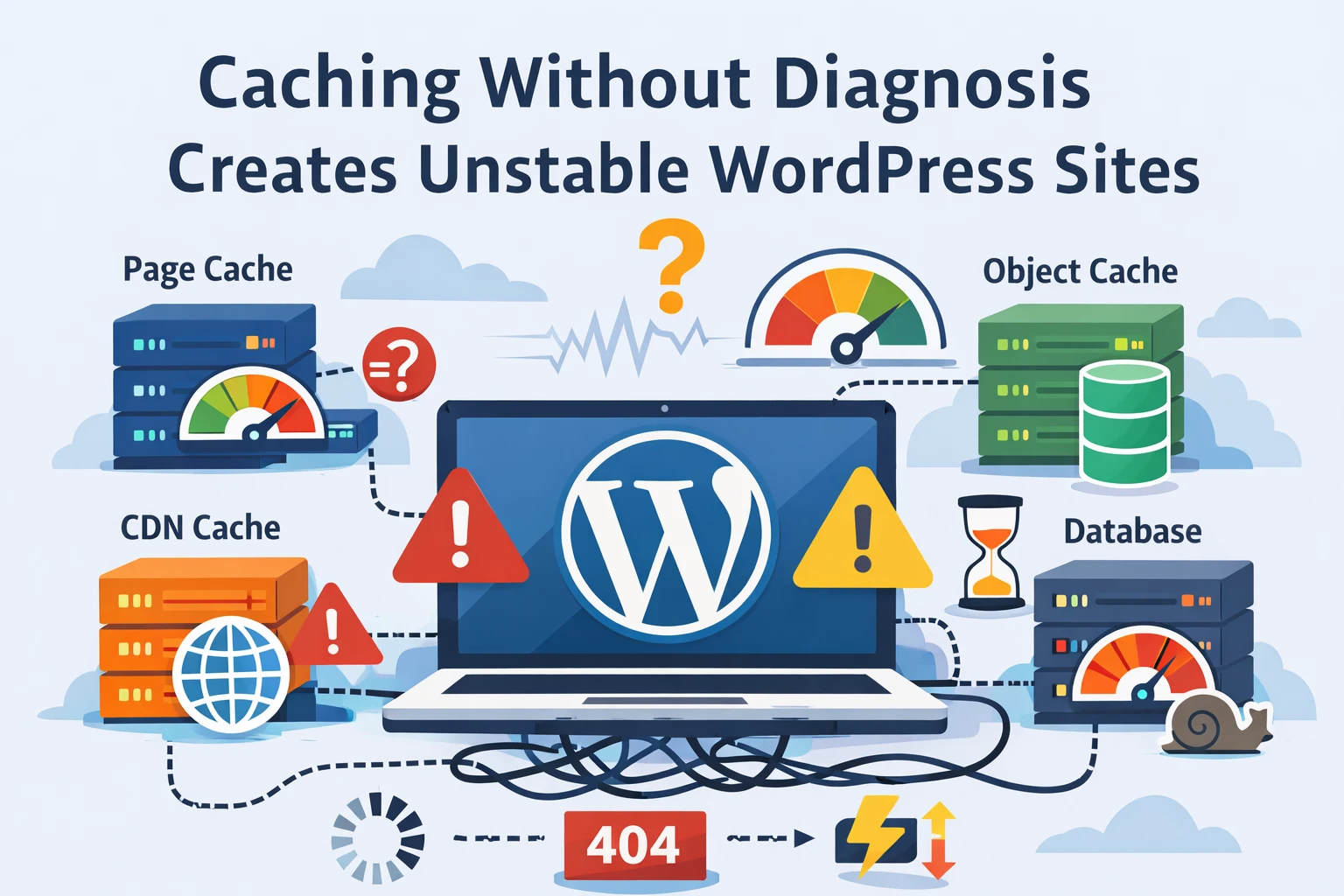
Caching is strongly associated with performance improvement.
When WordPress sites exhibit slowness, caching plugins often become the first intervention. Page caching, object caching, CDN integration, and optimization layers appear to offer immediate speed gains with minimal effort. Because these mechanisms are easy to deploy, many environments accumulate caching components rapidly.
However, caching does not inherently correct performance problems.
At Wisegigs.eu, performance investigations frequently reveal WordPress deployments where aggressive caching strategies increase inconsistency, introduce hard-to-reproduce failures, and complicate diagnosis. Despite additional layers intended to accelerate delivery, latency anomalies and unpredictable behavior often persist.
This outcome reflects a structural misunderstanding.
Caching modifies execution patterns.
It does not eliminate inefficiencies.
Caching Alters Behavior Rather Than Fixing Inefficiencies
Caching reduces repeated computation.
It does not optimize the underlying operations being cached. Expensive queries, inefficient hooks, or blocking operations remain unchanged. The system simply avoids executing them under specific conditions.
Consequently, performance characteristics become conditional.
Cache hits appear fast.
Cache misses reveal original latency.
Without understanding the source of slowness, caching becomes a masking layer rather than a corrective mechanism.
Modern performance guidance consistently emphasizes root cause analysis before optimization:
Performance Bottlenecks Persist Behind Cache Layers
Caching cannot remove structural constraints.
Database latency, synchronous external requests, inefficient template logic, and resource contention continue to define worst-case response times. When cache bypass events occur, these bottlenecks immediately resurface.
This behavior often surprises operators.
Sites may appear fast during testing yet degrade unpredictably in production.
Cache state, user context, and request variation influence outcomes.
Performance becomes inconsistent rather than reliably improved.
Cache Conflicts Introduce Non-Deterministic Failures
Multiple caching layers frequently interact poorly.
WordPress environments commonly combine page cache plugins, server-level caching, CDN caching, and object caching. Each layer maintains independent logic, expiration policies, and invalidation rules.
Coordination failures follow naturally.
Stale content delivery
Broken session behavior
Intermittent authentication issues
Unpredictable cache bypass
These effects rarely appear during initial configuration.
They emerge under real traffic conditions.
Object Caching Does Not Replace Query Discipline
Object caches accelerate repeated data retrieval.
They do not reduce query complexity or execution cost. Inefficient queries remain inefficient. Missing indexes remain missing. Excessive query volume remains excessive.
Redis, for example, improves retrieval latency for cached objects.
It does not correct pathological database access patterns.
Redis documentation explicitly frames caching as an optimization layer rather than a structural fix:
Stable performance still depends on query design.
Page Caching Creates Misleading Performance Signals
Page caching can obscure systemic inefficiencies.
Cached responses bypass application execution entirely. This behavior produces impressive speed measurements while hiding backend constraints. When cache misses occur, users encounter the original latency profile.
As a result, operators misinterpret performance data.
Synthetic benchmarks report excellent metrics.
Real users experience variability.
Diagnosis becomes harder because observed behavior diverges across request types.
Cache Invalidation Becomes a Hidden Failure Domain
Invalidation logic determines correctness.
Improper cache invalidation introduces stale data, inconsistent UI state, and functional anomalies. These issues frequently manifest as intermittent bugs rather than clear failures.
Typical symptoms include:
Recently updated content not appearing
Logged-in users seeing outdated data
Administrative changes behaving unpredictably
Invalidation complexity increases with system scale.
Predictability declines without deliberate design.
Cloudflare’s performance resources highlight these dynamics extensively:
https://www.cloudflare.com/learning/performance/
Why Stacked Caching Layers Increase Instability
Additional layers increase interaction complexity.
Each cache introduces its own storage behavior, eviction logic, and lifecycle management. Misalignment across layers creates emergent failure patterns that resist simple debugging.
Memory pressure may trigger evictions.
Evictions may trigger recomputation spikes.
Recomputation spikes may saturate backend resources.
Feedback loops develop quickly.
Systems oscillate between fast and slow states.
What Reliable Performance Optimization Prioritizes
Stable performance engineering begins with diagnosis.
Effective optimization strategies:
Identify dominant bottlenecks before caching
Measure query behavior explicitly
Validate cache hit ratios
Design invalidation logic carefully
Avoid redundant caching layers
Treat caching as an amplifier, not a cure
At Wisegigs.eu, caching decisions follow constraint identification rather than assumption.
Efficiency improvements precede acceleration mechanisms.
Conclusion
Caching increases performance potential.
It does not guarantee stability or correctness.
To recap:
Caching modifies execution behavior
Underlying inefficiencies persist
Cache conflicts introduce variability
Object caching cannot fix poor queries
Page caching may hide real bottlenecks
Invalidation logic becomes critical
Stacked caches increase instability
At Wisegigs.eu, sustainable WordPress performance improvements emerge from diagnosing constraints, correcting inefficiencies, and applying caching deliberately.
When caching precedes understanding, instability often follows.
If your WordPress site behaves inconsistently after deploying caching layers, the issue may not be caching itself — but the absence of diagnosis.