
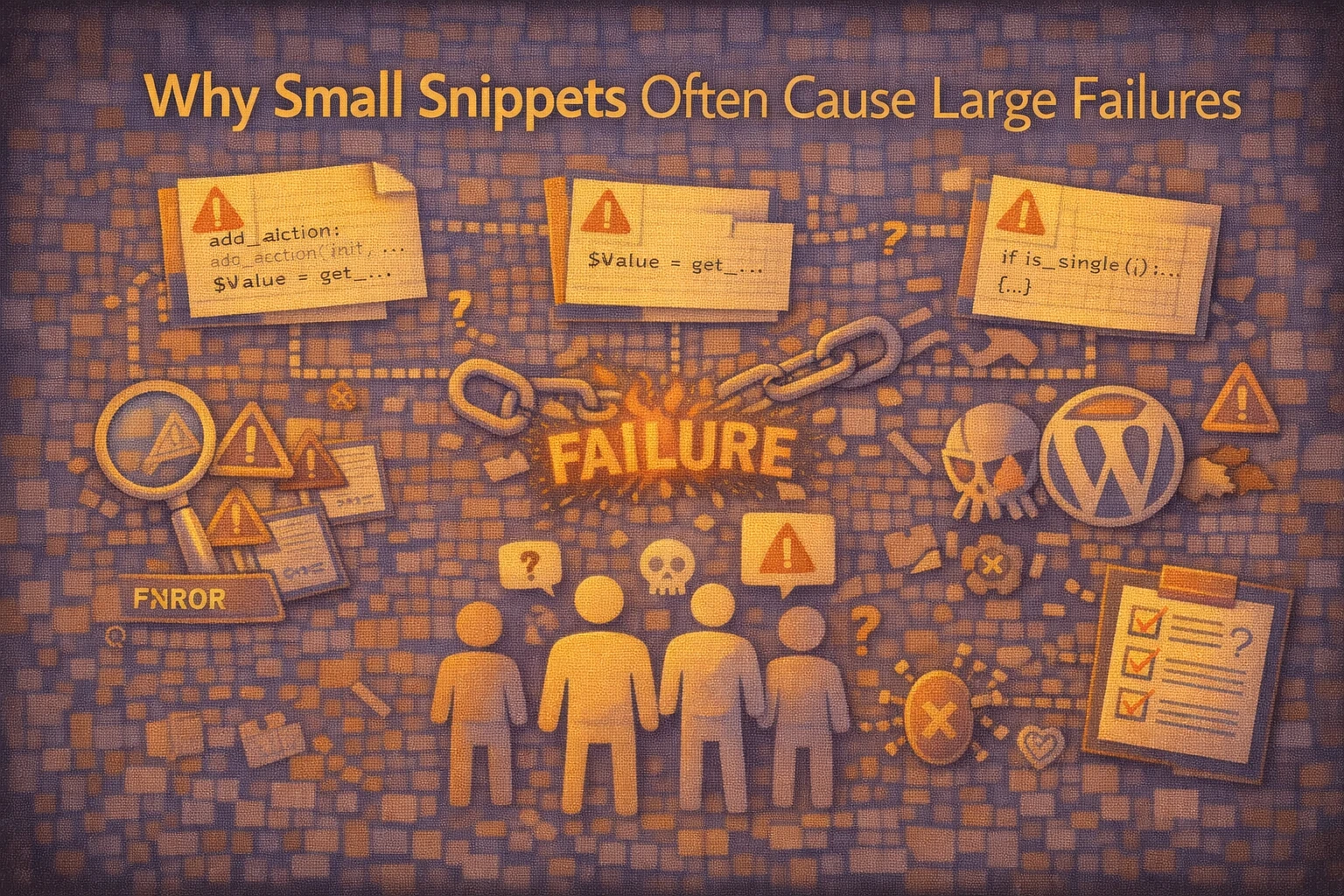
WordPress snippets are typically introduced as minor improvements.
A small tweak adjusts behavior. A quick fix resolves an edge case. A copied fragment adds missing functionality. Because these changes appear limited in scope, their long-term impact is rarely questioned.
However, snippets frequently become the origin of significant failures.
At Wisegigs.eu, many WordPress stability investigations reveal systems that degraded not because of major architectural changes but due to the gradual accumulation of small, isolated code fragments. Individually, these snippets appeared harmless. Collectively, they introduced fragility.
This article explains why minor code additions often produce disproportionate consequences, how snippet culture quietly increases risk, and why disciplined teams treat even small modifications as production-level decisions.
Snippets Bypass Architectural Boundaries
Snippets are rarely designed within a system model.
Most fragments are added reactively to solve immediate needs. Consequently, they often bypass structural considerations such as separation of concerns, dependency management, and lifecycle control.
While the site may continue functioning, hidden coupling increases.
Over time, this erosion of boundaries transforms maintainable systems into unpredictable ones.
Local Fixes Can Create Global Effects
WordPress executes within a shared runtime.
Hooks, filters, global state, and plugin interactions form an interconnected execution environment. Therefore, even small snippets can influence behavior far beyond their apparent scope.
A localized change may alter execution order, override assumptions, or modify shared data structures.
These effects rarely appear immediately, which makes them particularly dangerous.
Snippets Commonly Encode Fragile Assumptions
Quick fixes often rely on implicit expectations.
Execution timing, data availability, plugin presence, and request context are frequently assumed rather than validated. When surrounding conditions change, these assumptions fail silently.
Plugin updates, theme modifications, or infrastructure adjustments can expose latent weaknesses.
Code that once worked reliably may suddenly introduce instability.
WordPress core documentation consistently emphasizes using stable APIs and defensive logic:
https://developer.wordpress.org/apis/
Snippets rarely follow this discipline.
Maintenance Cost Grows Non-Linearly
Every snippet introduces cognitive overhead.
Future developers must understand not only what the code does but why it exists, which conditions it depends on, and how it interacts with other components. As snippet volume increases, comprehension difficulty expands rapidly.
Eventually, small changes require disproportionate effort.
Maintenance complexity becomes the failure driver.
Execution Conflicts Accumulate Gradually
Snippets often coexist without coordination.
Multiple fragments may target identical hooks, modify shared variables, or introduce competing logic. Because WordPress allows flexible extension, conflicts frequently remain undetected until specific conditions trigger unexpected behavior.
Failure patterns become intermittent and difficult to reproduce.
Systems appear unstable without obvious causes.
Debugging Becomes Increasingly Unpredictable
Fragmented logic complicates diagnosis.
When behavior emerges from numerous loosely related snippets, tracing root causes requires reconstructing execution paths across themes, plugins, and custom modifications.
Consequently, debugging time increases while confidence decreases.
Minor issues escalate into operational disruptions.
Snippets Encourage Reactive Development Habits
Snippet-driven workflows prioritize immediacy.
Short-term solutions often replace structured design, documentation, and validation. While this approach accelerates delivery, it also accumulates hidden debt that surfaces later as instability, update failures, or unexpected regressions.
Short-term convenience creates long-term risk.
Failure Rarely Occurs at the Moment of Introduction
Most snippets do not fail immediately.
Initial behavior appears correct. Side effects remain dormant. Because validation is typically superficial, latent problems survive until environmental changes expose them.
Delayed failure complicates accountability.
The snippet feels unrelated to the incident.
Why Small Snippets Produce Large Consequences
The scale of a change does not determine its impact.
In interconnected systems like WordPress, minor logic alterations can influence execution order, data flow, caching behavior, and plugin interactions. Therefore, seemingly trivial modifications may trigger cascading effects under specific conditions.
Small code does not imply small risk.
What Disciplined Teams Do Differently
Stable WordPress systems treat snippets as production code.
Effective teams:
Evaluate systemic impact before changes
Isolate custom logic into structured components
Document purpose and dependencies
Validate assumptions explicitly
Revisit snippets after updates
At Wisegigs.eu, snippets are managed through architectural discipline rather than convenience-driven workflows.
This approach reduces silent failure modes.
Conclusion
WordPress snippets are not inherently dangerous.
Unstructured snippet usage creates the problem.
To recap:
Snippets often bypass architectural boundaries
Local fixes can produce global effects
Assumptions frequently remain implicit
Maintenance cost grows rapidly
Conflicts accumulate silently
Debugging complexity increases
Failures emerge long after introduction
At Wisegigs.eu, resilient WordPress systems are built by recognizing that small code fragments can reshape system behavior in unexpected ways.
If your WordPress site feels fragile despite minor modifications, accumulated snippets may be the hidden cause.
Contact Wisegigs.eu