
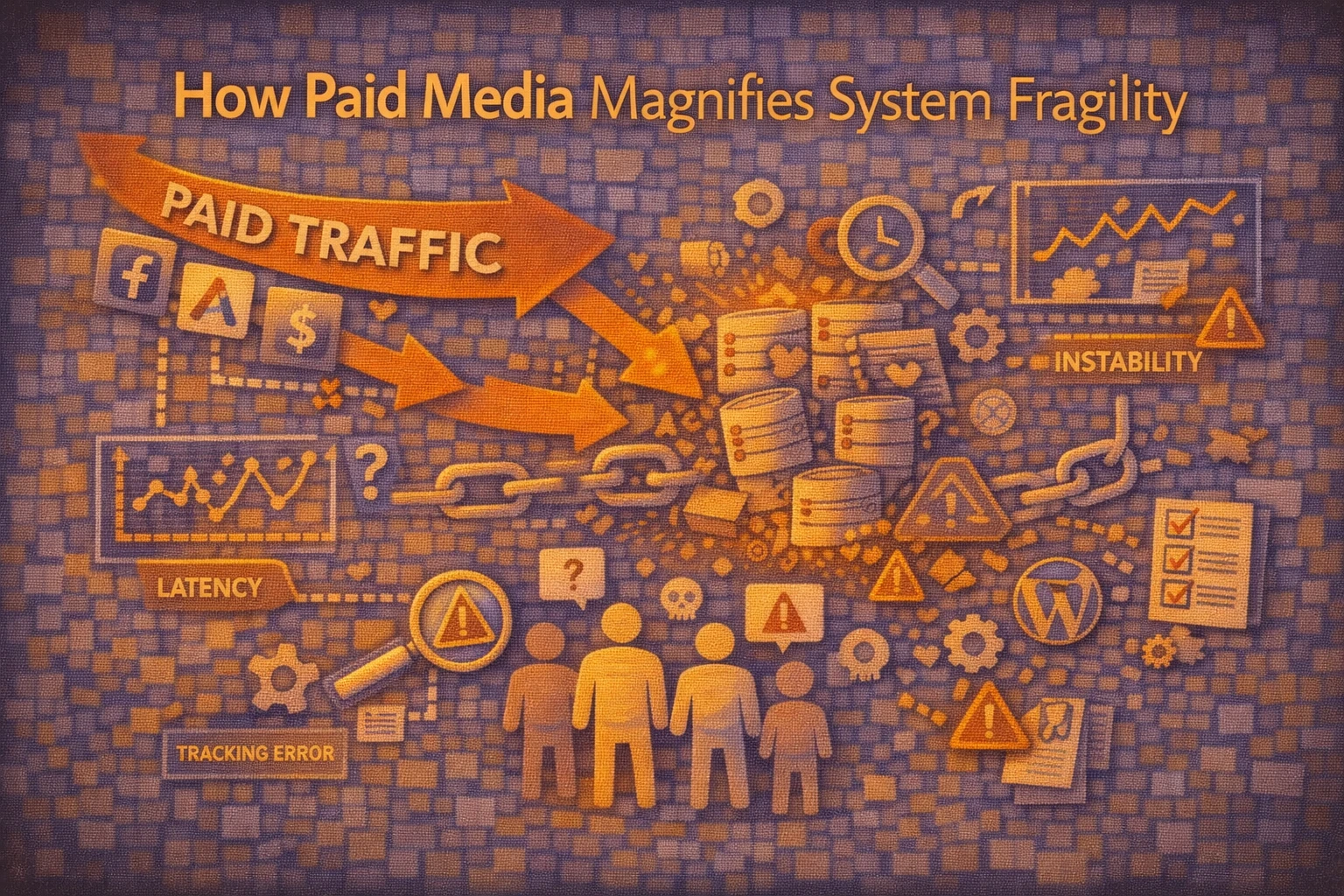
Paid media is often viewed as a growth accelerator.
More budget leads to more traffic. More traffic leads to more conversions. Because this logic appears straightforward, performance issues that emerge during campaign launches are frequently attributed to targeting, creatives, or bidding strategies.
In practice, however, paid traffic behaves differently.
At Wisegigs.eu, infrastructure slowdowns, tracking anomalies, and conversion instability often surface immediately after paid campaigns begin. These failures rarely originate in advertising platforms. Instead, they expose weaknesses already present in the system.
Paid media does not create fragility.
It reveals it at scale and speed.
Paid Traffic Alters System Stress Patterns
Organic growth tends to be gradual.
User flows evolve slowly, while infrastructure adapts over time. Consequently, minor inefficiencies may remain unnoticed for extended periods.
Paid campaigns disrupt this equilibrium.
Sudden traffic spikes introduce concentrated load, which changes request distribution, resource utilization, and behavioral dynamics. Systems that appear stable under normal conditions may degrade rapidly.
Traffic velocity becomes a structural variable.
Latent Performance Bottlenecks Surface Quickly
Every web system contains constraints.
Database queries, external requests, caching behavior, and script execution paths all influence responsiveness. Under low traffic, these bottlenecks may remain invisible.
Paid traffic amplifies execution frequency.
Operations that previously occurred sporadically now execute continuously. As a result, small inefficiencies escalate into observable slowdowns.
Scaling exposes what steady-state usage conceals.
Google’s performance research repeatedly emphasizes real-user conditions over synthetic assumptions:
https://web.dev/
Tracking Errors Become Strategically Dangerous
Measurement integrity becomes critical during paid acquisition.
Budget allocation, bidding decisions, and optimization cycles depend entirely on analytics accuracy. When tracking gaps or inconsistencies exist, paid campaigns amplify their consequences.
Incorrect signals drive incorrect decisions.
Unlike organic traffic, paid media directly converts measurement errors into financial losses.
Conversion Instability Appears Disproportionately
Conversion paths rarely fail under minimal load.
Forms submit correctly. Checkouts process normally. Session handling behaves predictably.
High-intensity traffic changes system behavior.
Race conditions, timeout effects, and resource contention introduce variability that disrupts user flows. Consequently, conversion degradation may appear unrelated to advertising performance.
Infrastructure behavior shapes marketing outcomes.
Paid Media Compresses Failure Timelines
Organic failures often emerge slowly.
Patterns develop across weeks or months, allowing gradual diagnosis. Paid campaigns compress these timelines dramatically.
System weaknesses surface within hours.
Rapid degradation creates diagnostic pressure, while root causes remain unclear. Because advertising activity coincides with failures, misattribution becomes common.
Correlation distorts troubleshooting logic.
Edge-Case Behavior Expands Under Scale
Low-volume traffic rarely exercises all execution paths.
Edge cases remain dormant, while error handling mechanisms experience limited stress. Paid campaigns expand behavioral diversity instantly.
Rare conditions become frequent.
Unexpected interactions increase, revealing weaknesses in validation logic, dependency management, and state handling.
Scale transforms improbability into inevitability.
Infrastructure Variability Becomes Visible
Virtualized environments inherently introduce variability.
Scheduling effects, shared resource dynamics, and network behavior influence response characteristics. Under steady load, these fluctuations may remain tolerable.
Paid traffic increases sensitivity.
Latency distribution widens, while jitter becomes perceptible. Users interpret this variability as instability, even when average metrics appear acceptable.
Consistency matters more than peaks.
Why Paid Media Commonly Gets Blamed Incorrectly
Advertising platforms are visible.
System architecture is not.
When failures coincide with campaigns, teams often assume paid media is the cause rather than the trigger. In reality, paid traffic simply accelerates exposure of preexisting weaknesses.
The messenger becomes the scapegoat.
What Resilient Systems Assume About Paid Traffic
Stable systems anticipate variability and bursts.
Resilient architectures:
Tolerate traffic spikes gracefully
Isolate expensive operations
Validate tracking integrity continuously
Monitor latency distribution
Prioritize bottleneck elimination
At Wisegigs.eu, paid campaign readiness is treated as a systems reliability concern rather than a marketing configuration task.
Performance discipline precedes scaling.
Conclusion
Paid media does not destabilize healthy systems.
Instead, it exposes fragility already embedded within performance behavior, tracking logic, and infrastructure constraints.
To recap:
Paid traffic alters stress patterns
Bottlenecks surface rapidly
Tracking errors become costly
Conversion instability increases
Failure timelines compress
Edge cases expand
Infrastructure variability becomes visible
At Wisegigs.eu, stable growth strategies recognize that paid media acts as a diagnostic amplifier. Systems designed for resilience interpret these signals correctly.
If paid campaigns trigger unexpected instability, the weakness may not exist in the ads — but in the system receiving the traffic.
Contact Wisegigs.eu