
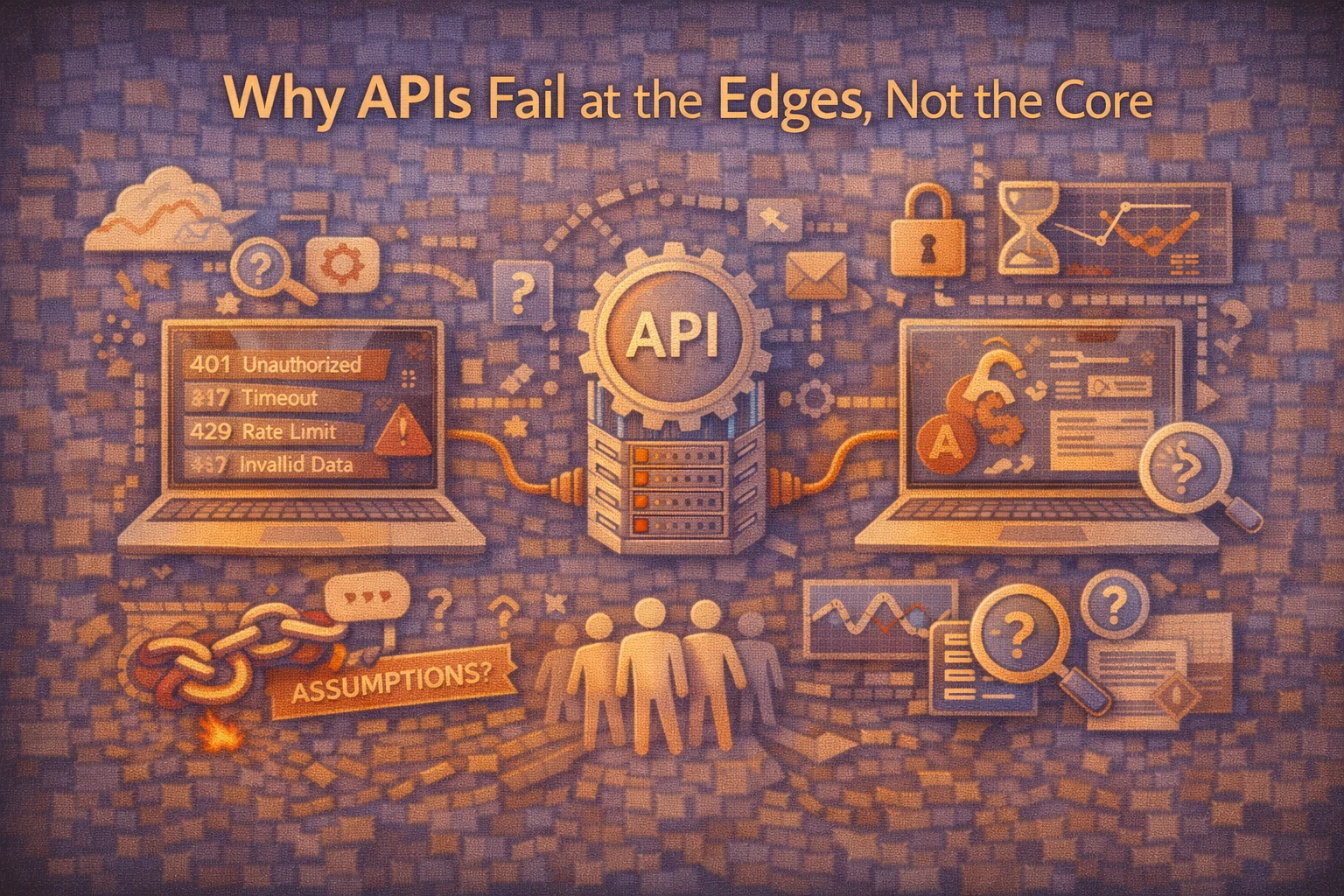
API failures are frequently misdiagnosed.
When integrations break, teams often assume that the underlying service is unreliable, poorly implemented, or inherently unstable. Because APIs are treated as discrete components, failure is commonly attributed to the provider rather than the interaction model.
In practice, however, most API failures do not originate in the core system.
At Wisegigs.eu, integration instability typically emerges at the edges — where assumptions, environments, and behaviors intersect. The API itself may operate exactly as designed, yet surrounding conditions introduce fragility that only becomes visible under real-world usage.
This article explains why API failures concentrate at system boundaries, how integration assumptions generate risk, and why reliability depends more on context management than endpoint correctness.
Core Systems Are Usually Predictable
Mature APIs are heavily tested.
Providers validate request handling, authentication logic, data structures, and response consistency across numerous scenarios. Consequently, core behaviors tend to be stable within defined operating conditions.
Most reliability problems appear outside those conditions.
When failures occur, they often reflect mismatches between consumer expectations and system guarantees rather than defects in the API itself.
Edges Contain Hidden Assumptions
Every integration encodes expectations.
Timeout thresholds, retry logic, payload formats, authentication flows, and error handling mechanisms all assume specific system responses. When these assumptions misalign with reality, instability emerges even though both systems function correctly.
Importantly, assumption failures rarely trigger obvious errors.
Instead, they produce intermittent behavior that complicates diagnosis.
Network Conditions Distort Reliability
APIs operate across networks.
Latency fluctuations, packet loss, routing variability, and transient connectivity issues introduce uncertainty independent of application logic. Therefore, stable endpoints may appear unreliable when network conditions degrade.
Google’s distributed systems research highlights how network behavior shapes system reliability:
https://sre.google/sre-book/
Edge instability is often environmental rather than architectural.
Error Handling Determines Integration Stability
Unexpected responses are inevitable.
Rate limits, partial failures, dependency delays, and service throttling occur even in well-managed systems. Consequently, integration reliability depends heavily on how consumers interpret and respond to these conditions.
Weak error handling amplifies minor disruptions.
Robust error handling absorbs variability.
Data Contracts Drift Over Time
APIs evolve.
Fields are added, deprecated, or restructured. Validation rules change. Response formats expand. While versioning strategies attempt to preserve compatibility, consumer assumptions frequently diverge from provider behavior.
Without disciplined contract management, edge failures accumulate silently.
Backward compatibility reduces risk. It does not eliminate it.
Authentication and Authorization Add Complexity
Security layers introduce failure modes.
Token expiration, clock skew, permission changes, and credential rotation create instability unrelated to business logic. As a result, integrations may fail despite correct request structures.
Edge failures often manifest as authorization anomalies rather than functional errors.
Retry Logic Can Amplify Failure
Retries are designed to improve resilience.
However, poorly designed retry mechanisms frequently increase load during partial outages. Consequently, transient failures escalate into systemic degradation.
Reliable integrations balance retry behavior with system capacity and failure characteristics.
Automation without control magnifies instability.
Observability Defines Troubleshooting Capability
Integration failures are rarely deterministic.
Without detailed logging, request tracing, and response visibility, teams struggle to distinguish between API defects, network anomalies, and consumer-side errors.
Effective observability transforms intermittent failures into diagnosable events.
Unobserved edges create persistent uncertainty.
Why Edge Failures Are Systemic, Not Accidental
System boundaries are inherently unstable zones.
Different ownership models, independent release cycles, variable environments, and incomplete shared assumptions create structural friction. Therefore, edge failures are not exceptional anomalies.
They are predictable system behaviors.
Resilient architectures acknowledge this reality explicitly.
What Reliable API Integrations Prioritize
Stable integrations require disciplined design:
Explicit assumption validation
Defensive error handling
Controlled retry strategies
Contract evolution awareness
Comprehensive observability
Environment consistency
At Wisegigs.eu, API reliability is evaluated primarily through boundary behavior rather than endpoint correctness.
Edges determine stability.
Conclusion
APIs rarely fail because their core logic collapses.
Instead, failures concentrate at interaction boundaries where assumptions, latency, contracts, and behaviors intersect.
To recap:
Core systems are typically stable
Edge assumptions introduce fragility
Network conditions distort reliability
Error handling shapes outcomes
Contracts drift over time
Authentication layers add failure modes
Retries can amplify disruption
Observability enables diagnosis
At Wisegigs.eu, resilient systems treat API integration as a reliability design problem rather than a connectivity task.
If your integrations fail unpredictably, the weakness may not exist in the API — but at the edges surrounding it.
Contact Wisegigs.eu