
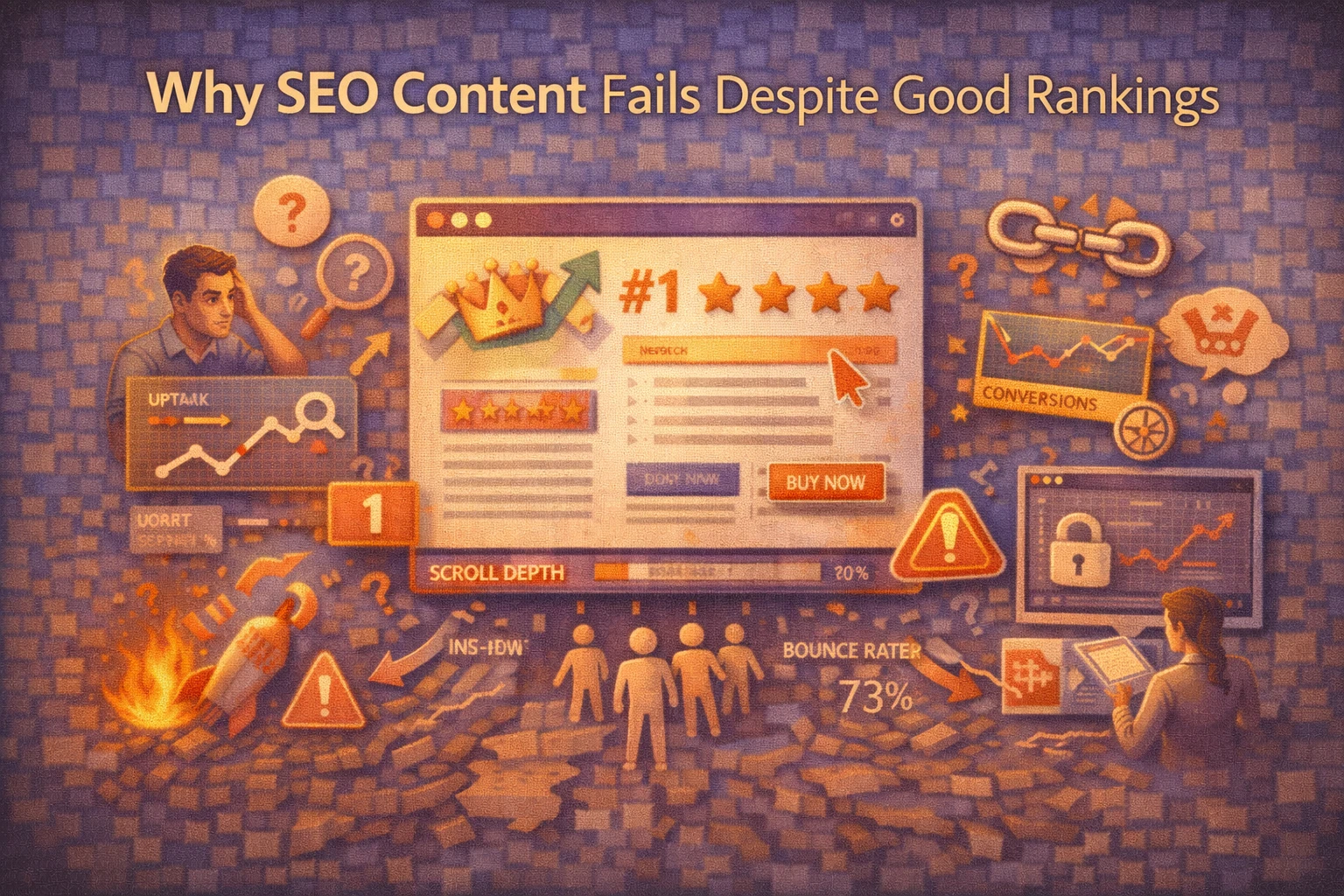
Strong rankings often create a sense of success.
When pages reach the first page of search results, teams assume their SEO strategy is working. Traffic appears to increase, visibility improves, and dashboards look reassuring. Because of this, deeper performance analysis is frequently deprioritized.
However, rankings alone do not guarantee meaningful outcomes.
At Wisegigs.eu, many SEO investigations begin in environments where keyword positions appear healthy. Despite this visibility, conversions stagnate, engagement remains weak, or business impact fails to materialize.
This article explains why SEO content can underperform even with strong rankings, how misleading signals distort strategy decisions, and what sustainable search success actually requires.
Rankings Measure Visibility, Not Effectiveness
Search rankings indicate relative position.
They do not measure user satisfaction, intent alignment, or conversion probability. Consequently, high-ranking pages may attract impressions without generating meaningful engagement.
Users decide value after clicking, not before.
Google’s Search Quality documentation reinforces that relevance and usefulness determine long-term performance:
https://developers.google.com/search/docs/fundamentals/creating-helpful-content
Visibility without effectiveness produces fragile growth.
Traffic Growth Can Mask Behavioral Mismatch
Increased traffic feels like progress.
Nevertheless, traffic volume alone does not confirm that visitors represent the intended audience. When content attracts curiosity rather than qualified interest, engagement metrics often disappoint.
For example, informational queries may drive sessions without supporting business goals.
Without evaluating intent alignment, traffic becomes a misleading success signal.
Search Intent Misalignment Undermines Performance
Keyword relevance is not enough.
Even when content targets high-value terms, mismatches between search intent and page structure frequently suppress results. As a result, visitors may leave quickly despite arriving through accurate queries.
Ahrefs’ research on search intent highlights how intent mismatch affects outcomes:
https://ahrefs.com/blog/search-intent/
Successful SEO requires behavioral alignment, not only semantic optimization.
Engagement Metrics Reveal Hidden Weaknesses
Surface metrics rarely tell the full story.
Bounce rates, time on page, scroll depth, and return behavior often expose weaknesses invisible to ranking reports. Consequently, pages that appear successful in search results may struggle to retain user attention.
Without analyzing post-click behavior, teams risk misinterpreting performance stability.
Content Structure Shapes User Decisions
Users scan before reading.
Visual hierarchy, information density, clarity of messaging, and cognitive load all influence engagement. Therefore, technically optimized content may still fail when structure impedes comprehension.
Google’s UX and readability guidance emphasizes clarity and usability:
https://web.dev/learn/design/
Content quality is inseparable from presentation.
Competitive Context Distorts Ranking Significance
Rankings are relative.
A first-page position within a low-intent or low-value query space may produce limited impact. Conversely, lower positions for highly aligned queries may generate stronger outcomes.
Therefore, position alone cannot determine strategic success.
Meaningful evaluation requires contextual analysis.
Content Often Targets Queries, Not Decisions
Many SEO strategies optimize for discovery.
However, discovery does not guarantee decision-making. When content fails to remind visitors of next steps, value propositions, or conversion pathways, performance gaps emerge.
Search traffic without decision architecture limits business impact.
Algorithmic Stability Does Not Equal Strategic Stability
Search algorithms evolve continuously.
Pages that rank well today may decline tomorrow due to shifts in relevance models, competitor behavior, or intent interpretation. Consequently, strategies dependent solely on rankings become inherently unstable.
Google explicitly warns against overreliance on ranking positions:
https://developers.google.com/search/blog/
Sustainable SEO prioritizes user value over positional metrics.
What Sustainable SEO Success Looks Like
Reliable SEO systems measure outcomes beyond rankings.
Effective teams:
Evaluate encouraging intent alignment
Monitor behavioral engagement patterns
Optimize structure alongside keywords
Validate traffic quality continuously
Correlate visibility with business impact
At Wisegigs.eu, rankings are treated as indicators, not conclusions.
This mindset prevents false confidence.
Conclusion
SEO content can fail despite strong rankings.
Visibility alone does not guarantee effectiveness, alignment, or conversion impact.
To recap:
Rankings measure position, not value
Traffic growth may hide mismatches
Intent alignment determines relevance
Engagement metrics expose weaknesses
Structure influences user behavior
Competitive context matters
Algorithms shift continuously
At Wisegigs.eu, sustainable search performance depends on understanding that rankings are signals within a larger behavioral system.
If your pages rank well yet produce weak outcomes, the problem may not be SEO visibility — but SEO alignment.
Contact Wisegigs.eu