
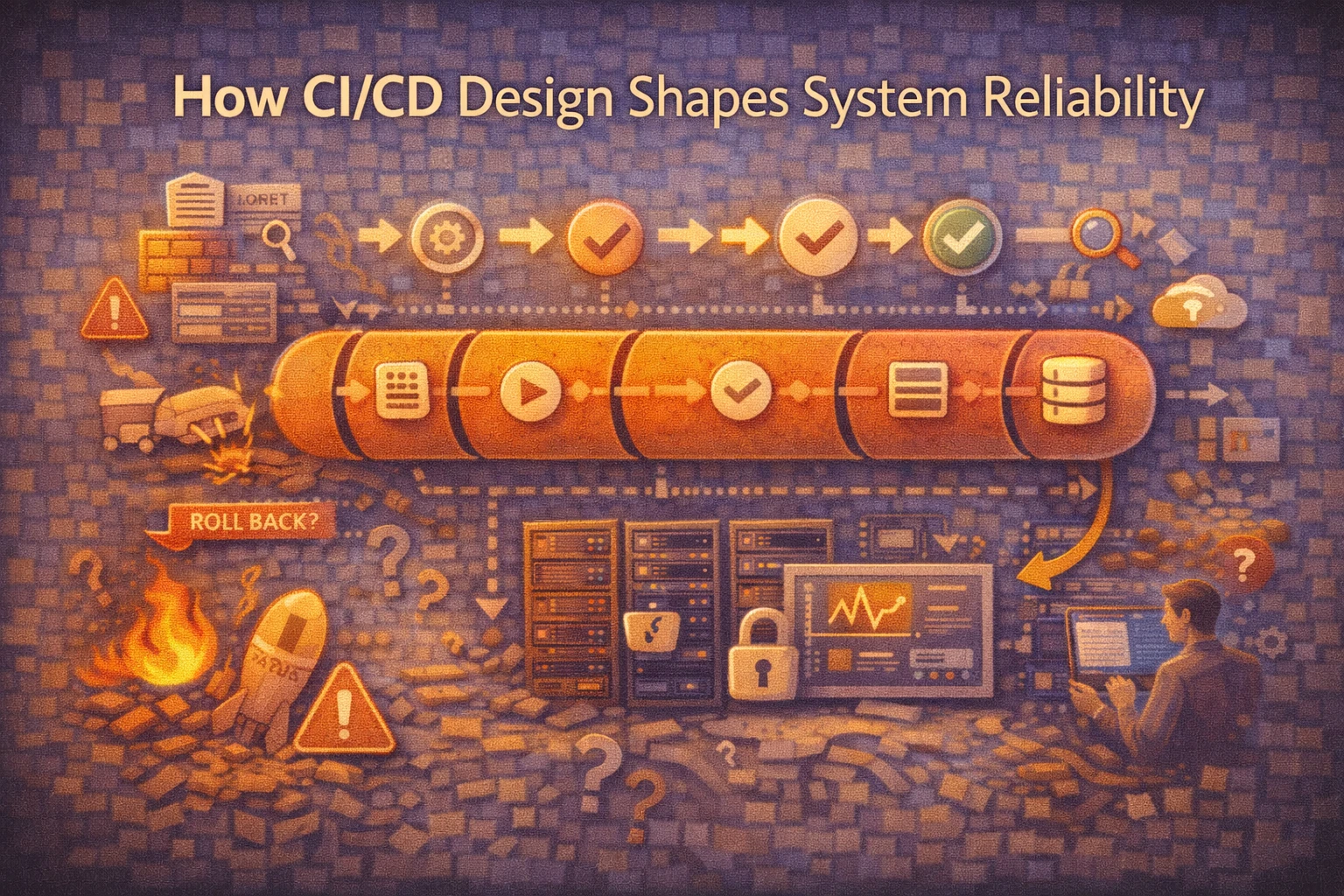
Continuous Integration and Continuous Delivery are widely associated with speed.
Teams invest heavily in pipelines to accelerate releases, reduce manual work, and standardize deployment workflows. Because automation dominates the conversation, CI/CD is often treated as a tooling decision rather than a system design discipline.
However, delivery speed alone does not guarantee reliability.
At Wisegigs.eu, many stability investigations trace back to CI/CD design choices rather than infrastructure limitations or software defects. Pipelines that function correctly may still introduce fragility when their structure conflicts with system behavior.
This article explains how CI/CD design directly influences reliability, why automation can amplify instability, and what resilient delivery models do differently.
CI/CD Pipelines Encode Operational Assumptions
Every pipeline reflects implicit expectations.
Deployment order, rollback behavior, dependency handling, and validation stages all assume specific system conditions. When these assumptions misalign with reality, reliability degrades despite technically successful builds.
For example, pipelines may assume stateless services, predictable startup behavior, or immediate dependency availability. Under real workloads, such assumptions frequently fail.
Google’s Site Reliability Engineering principles emphasize validating system behavior rather than relying on theoretical models:
https://sre.google/sre-book/
Pipelines do not operate in isolation from architecture.
Automation Amplifies Both Correctness and Failure
Automation accelerates execution.
Unfortunately, it also accelerates mistakes.
When CI/CD workflows propagate flawed configurations, unsafe deployment strategies, or incomplete validation logic, failures scale rapidly. As a result, systemic weaknesses spread faster than manual processes would allow.
Well-designed pipelines increase stability. Poorly designed ones increase failure velocity.
Reliability Depends on Deployment Strategy, Not Just Frequency
Frequent releases are often viewed as inherently beneficial.
However, deployment reliability depends more on strategy than cadence. Canary releases, staged rollouts, validation gates, and failure isolation mechanisms determine whether continuous delivery improves or degrades stability.
Without protective design patterns, rapid deployment cycles amplify disruption rather than reduce risk.
The DevOps Research and Assessment (DORA) findings highlight this relationship between delivery practices and reliability outcomes:
https://dora.dev/
Speed without control increases instability.
Pipeline Complexity Introduces Hidden Risk
Pipelines grow over time.
Additional stages, conditional logic, environment variations, and dependency checks accumulate gradually. While each modification may appear harmless, collective complexity introduces fragility.
Complex pipelines are harder to reason about, validate, and recover from.
Consequently, failure modes multiply even when automation appears sophisticated.
Rollback Design Determines Incident Severity
Rollback behavior is a critical reliability factor.
Pipelines that lack deterministic rollback paths often transform minor issues into major incidents. When recovery requires manual intervention or unclear procedures, downtime increases.
Reliable CI/CD design treats rollback as a first-class workflow rather than an afterthought.
Resilient systems expect failure and engineer reversibility.
Environment Consistency Shapes Stability
CI/CD pipelines depend on predictable environments.
Differences between staging and production, inconsistent dependencies, and configuration divergence frequently generate unexpected failures. As a result, deployments succeed in testing yet fail in production.
The Twelve-Factor App methodology reminds teams that environment parity is essential for reliable systems:
https://12factor.net/
Pipeline reliability requires environmental discipline.
Observability Determines Post-Deployment Confidence
Successful deployment does not guarantee healthy systems.
Monitoring, logging, metrics, and alerting mechanisms determine whether teams can validate system behavior after release. Without observability, pipelines provide delivery confirmation without operational assurance.
Reliable pipelines integrate measurement, not just execution.
CI/CD Design Influences Failure Containment
System reliability depends on failure isolation.
Pipelines that deploy large changes simultaneously increase blast radius. Conversely, pipelines designed for incremental updates, controlled exposure, and progressive validation reduce incident impact.
Failure containment is a design decision, not a tooling feature.
What Reliable CI/CD Design Looks Like
Resilient delivery models prioritize stability alongside speed.
Effective teams:
Validate assumptions continuously
Minimize unnecessary pipeline complexity
Engineer deterministic rollback paths
Enforce environment consistency
Integrate observability into workflows
Treat deployment as risk management
At Wisegigs.eu, CI/CD is treated as a reliability architecture component rather than a release automation mechanism.
This mindset reduces silent failure modes.
Conclusion
CI/CD pipelines do more than deliver software.
They shape system behavior, failure patterns, and operational risk.
To recap:
Pipelines encode operational assumptions
Automation amplifies both success and failure
Deployment strategy determines stability
Complexity introduces hidden fragility
Rollback design influences incident severity
Environment consistency affects reliability
Observability enables confidence
At Wisegigs.eu, reliable delivery systems are built by aligning CI/CD design with real-world system dynamics rather than pursuing automation for its own sake.
If deployments frequently introduce instability, the problem may not be release frequency — but pipeline design.
Contact Wisegigs.eu