
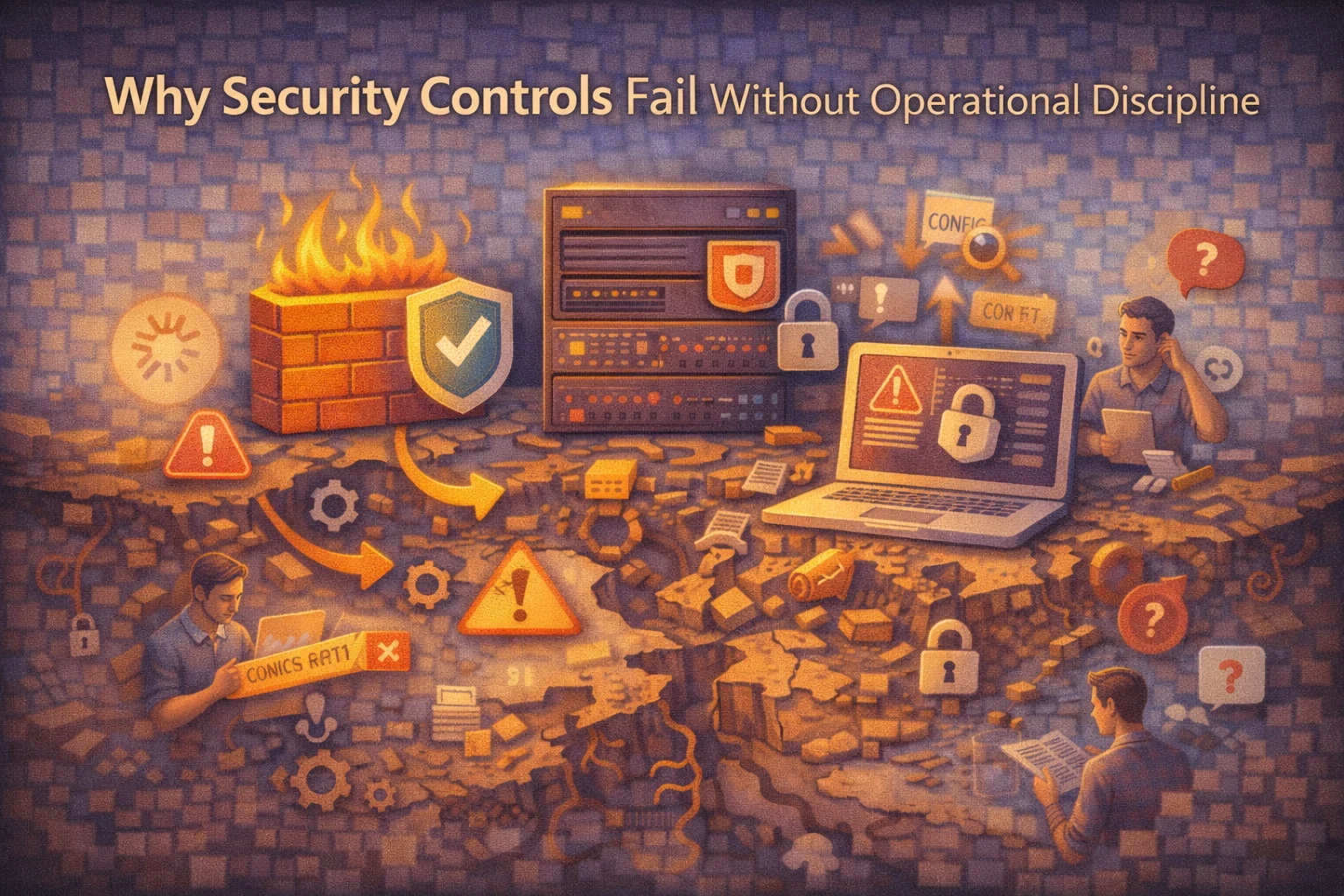
Security controls are widely treated as protective guarantees.
Firewalls, intrusion detection systems, malware scanners, and access controls create a reassuring sense of safety. Because these mechanisms are visible and measurable, organizations often assume that deploying them significantly reduces risk.
In practice, however, security controls frequently fail.
At Wisegigs.eu, many infrastructure security incidents occur in environments equipped with modern tooling. The underlying issue is rarely the absence of controls. Instead, failures emerge from operational weaknesses that quietly undermine otherwise sound security mechanisms.
This article explains why controls alone cannot ensure protection, how operational discipline determines real-world security outcomes, and why process failures often precede technical ones.
Controls Operate Within Systems, Not in Isolation
Security mechanisms depend on their environment.
Even well-designed controls require correct configuration, consistent maintenance, and predictable execution conditions. Without these foundations, protective layers degrade despite appearing functional.
For example, misaligned policies, inconsistent updates, and incomplete monitoring frequently weaken controls without triggering immediate alarms.
NIST’s cybersecurity guidance emphasizes that security effectiveness relies on continuous operational processes:
https://www.nist.gov/cyberframework
Tools do not eliminate systemic fragility.
Configuration Drift Undermines Protection
Infrastructure evolves constantly.
Services change, dependencies update, and workloads shift. Over time, configuration states diverge from their intended design. Consequently, controls calibrated for previous conditions may behave unpredictably.
This phenomenon, known as configuration drift, introduces silent vulnerabilities.
Without disciplined validation cycles, even robust security architectures lose reliability.
Monitoring Gaps Delay Detection
Controls prevent and detect threats.
However, detection mechanisms require observability. When logging pipelines are incomplete or alerts are poorly tuned, security failures remain invisible until damage escalates.
Importantly, missing signals often matter more than negative ones.
Google’s Site Reliability Engineering principles highlight the necessity of monitoring for reliable system behavior:
https://sre.google/sre-book/monitoring-distributed-systems/
Unobserved controls cannot guarantee safety.
Operational Inconsistency Creates Weak Links
Security policies demand consistent enforcement.
Yet many environments rely on manual processes, undocumented exceptions, or ad hoc changes. As a result, controls operate under uneven conditions.
Inconsistent privilege management, irregular patching, and fragmented ownership models amplify risk.
Even minor operational gaps create exploitable opportunities.
Security Failures Rarely Appear as Control Failures
Incidents seldom announce themselves clearly.
Instead of obvious control breakdowns, organizations often observe secondary symptoms such as performance anomalies, intermittent access issues, or unexplained resource usage.
Because these signals resemble operational noise, root causes remain obscured.
Consequently, remediation efforts may target symptoms rather than systemic weaknesses.
Automation Without Discipline Increases Risk
Automation is frequently positioned as a solution.
While automation reduces manual error, it also accelerates mistakes when underlying processes lack rigor. Poorly defined workflows propagate misconfigurations at scale.
Therefore, automation amplifies both correctness and failure.
Disciplined operational models determine which outcome dominates.
Controls Cannot Compensate for Human Factors
Human decisions shape security posture.
Access grants, policy exceptions, incident response actions, and maintenance practices all influence system integrity. When organizational processes lack structure, controls inherit those weaknesses.
Security failures are often procedural before technical.
Industry security research consistently reinforces this relationship between process discipline and control effectiveness:
https://www.cisa.gov/
What Operational Discipline Actually Means
Operational discipline is not rigidity.
Instead, it reflects predictable, validated system management. Effective environments:
Enforce consistent configuration standards
Validate control behavior continuously
Maintain comprehensive monitoring
Document changes and ownership clearly
Treat anomalies as investigation triggers
At Wisegigs.eu, security controls are evaluated within the context of operational stability rather than tool presence.
This approach reduces silent failure modes.
Why Controls Alone Create False Confidence
Visible defenses influence perception.
When controls exist, stakeholders assume protection. Consequently, deeper operational weaknesses may remain unexamined.
Over time, this false confidence increases exposure.
Controls appear functional while risk accumulates beneath the surface.
Conclusion
Security controls are necessary.
They are not sufficient.
To recap:
Controls depend on operational context
Configuration drift weakens protection
Monitoring gaps delay detection
Inconsistent processes introduce vulnerabilities
Automation amplifies both success and failure
Human factors shape security outcomes
At Wisegigs.eu, resilient hosting environments treat security as an operational discipline rather than a tooling checklist.
If security incidents continue despite layered defenses, the missing element may not be another control — but stronger operational discipline.
Contact Wisegigs.eu