
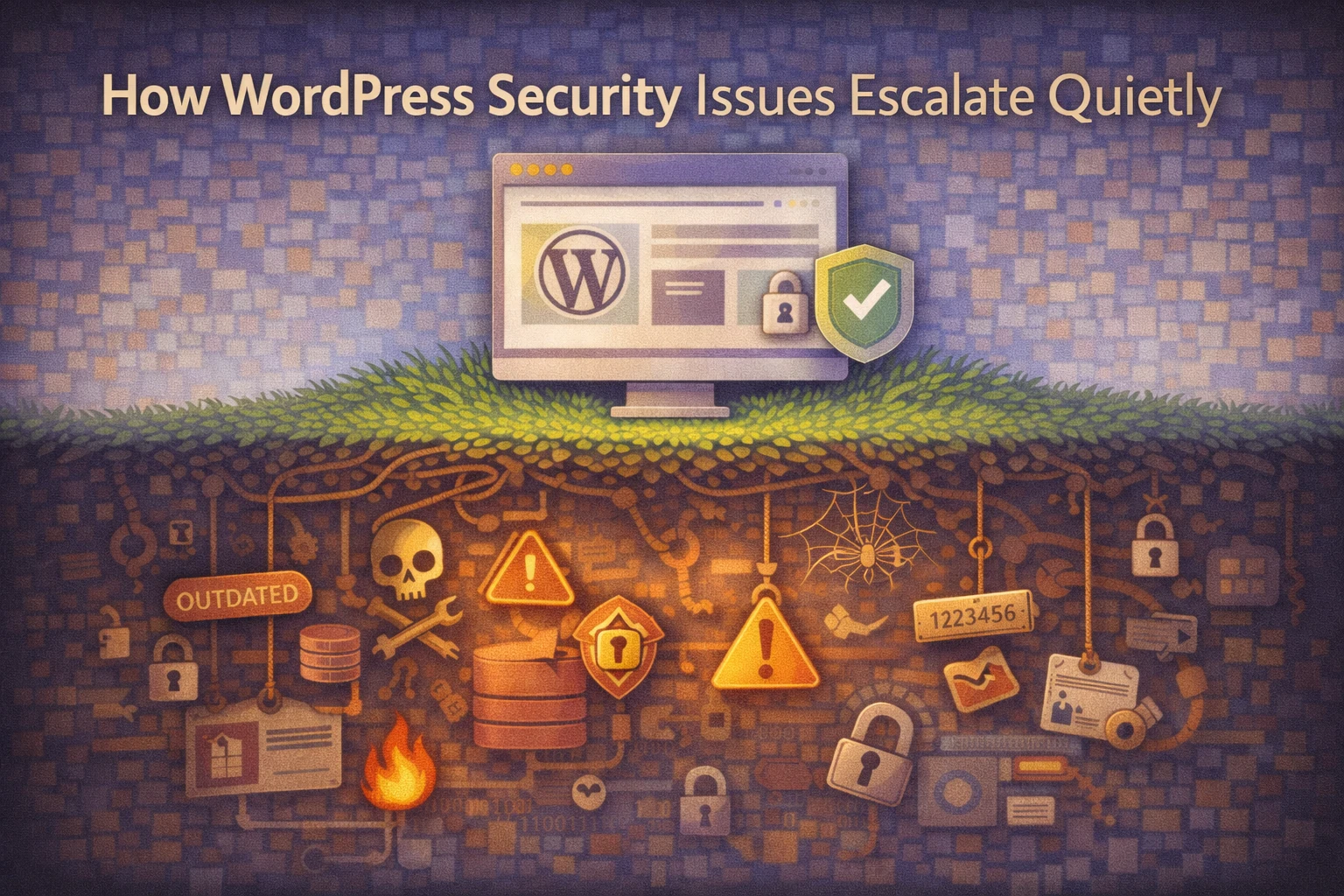
Most WordPress security failures do not begin with dramatic events.
No alarms sound. No obvious breach occurs. The site continues to function, often without visible symptoms. Because everything appears stable, early warning signs are frequently ignored.
Over time, however, small weaknesses accumulate.
At Wisegigs.eu, many security incidents originate from conditions that existed long before detection. These issues rarely announce themselves. Instead, they escalate quietly until instability, compromise, or operational disruption becomes unavoidable.
This article explains why WordPress security problems often remain invisible, how minor oversights evolve into serious risks, and why reactive approaches consistently fail.
Security Failures Rarely Start With Attackers
Contrary to popular belief, many vulnerabilities originate internally.
Outdated plugins, inconsistent updates, excessive privileges, and configuration drift introduce risk without any malicious activity. In these cases, attackers simply exploit conditions that already exist.
Therefore, the root cause is often structural rather than adversarial.
The WordPress Hardening Guide emphasizes reducing unnecessary exposure before incidents occur:
https://wordpress.org/support/article/hardening-wordpress/
Without disciplined maintenance, risk grows silently.
Small Weaknesses Compound Over Time
Individual issues rarely appear catastrophic.
A delayed update, an unused plugin, or a permissive file setting may seem harmless in isolation. However, security failures rarely result from single mistakes.
Instead, risk compounds gradually.
As components interact, attack surfaces expand. Eventually, multiple minor weaknesses align to create significant vulnerabilities.
This compounding effect explains why seemingly stable sites fail unexpectedly.
Outdated Components Create Invisible Exposure
Unpatched software introduces known vulnerabilities.
Many exploits target publicly documented weaknesses rather than novel attack techniques. When plugins or themes remain outdated, exposure increases regardless of perceived site activity.
Importantly, inactive vulnerabilities still represent risk.
The WordPress Developer Resources highlight the importance of timely updates:
https://developer.wordpress.org/plugins/security/
Ignoring updates does not freeze risk. It magnifies it.
Misplaced Trust Masks Emerging Problems
Security tooling often creates false confidence.
Firewalls, scanners, and security plugins provide valuable protections. Nevertheless, tools cannot compensate for unsafe architecture, weak permissions, or poor operational discipline.
When teams assume that tooling guarantees safety, deeper issues remain unaddressed.
As a result, vulnerabilities persist beneath a layer of perceived protection.
Compromise Indicators Frequently Go Unnoticed
Security degradation is rarely obvious.
Subtle performance changes, unexpected resource usage, minor file modifications, or irregular login behavior often precede major incidents. Because these signals appear ambiguous, they are commonly dismissed.
Unfortunately, delayed recognition allows problems to expand.
Google’s Web Security guidance stresses continuous monitoring and anomaly detection:
https://web.dev/security/
Without visibility, escalation accelerates.
Reactive Security Encourages Late Intervention
Many teams respond only after visible symptoms emerge.
Malware detection, defacement, downtime, or user complaints finally trigger investigation. By that stage, remediation becomes more complex and disruptive.
Reactive security strategies inherently accept escalation before action.
Preventative approaches, by contrast, reduce failure probability long before incidents occur.
Access Control Errors Amplify Risk
Improper permissions introduce systemic vulnerabilities.
Excessive administrator accounts, shared credentials, or inconsistent privilege boundaries expand the potential impact of any compromise. Even minor breaches become severe when access controls are weak.
Stable systems minimize privilege, not merely protect endpoints.
This principle remains fundamental across all secure architectures.
What Quiet Escalation Looks Like in Practice
Gradual security degradation often follows recognizable patterns:
Updates become irregular
Plugins accumulate without review
Permissions drift from intended states
Monitoring remains incomplete
Ownership becomes unclear
None of these issues appear urgent individually.
Collectively, however, they create unstable environments.
How Reliable WordPress Security Differs
Resilient WordPress environments rely on discipline rather than assumptions.
Effective teams:
Maintain consistent update cycles
Minimize unnecessary components
Enforce strict privilege boundaries
Monitor system behavior continuously
Treat anomalies as signals, not noise
At Wisegigs.eu, security is treated as an operational process rather than a plugin selection.
This mindset prevents silent escalation.
Conclusion
WordPress security issues rarely escalate through sudden failure.
Instead, they grow quietly within neglected systems.
To recap:
Vulnerabilities often originate internally
Minor weaknesses compound gradually
Outdated components increase exposure
Tooling can mask deeper problems
Early indicators frequently go unnoticed
Reactive security delays intervention
Weak access control amplifies impact
At Wisegigs.eu, long-term WordPress stability depends on recognizing that security failures are usually slow, silent, and preventable.
If your WordPress site appears healthy but feels fragile, hidden security risk may already be accumulating.
Contact Wisegigs.eu