
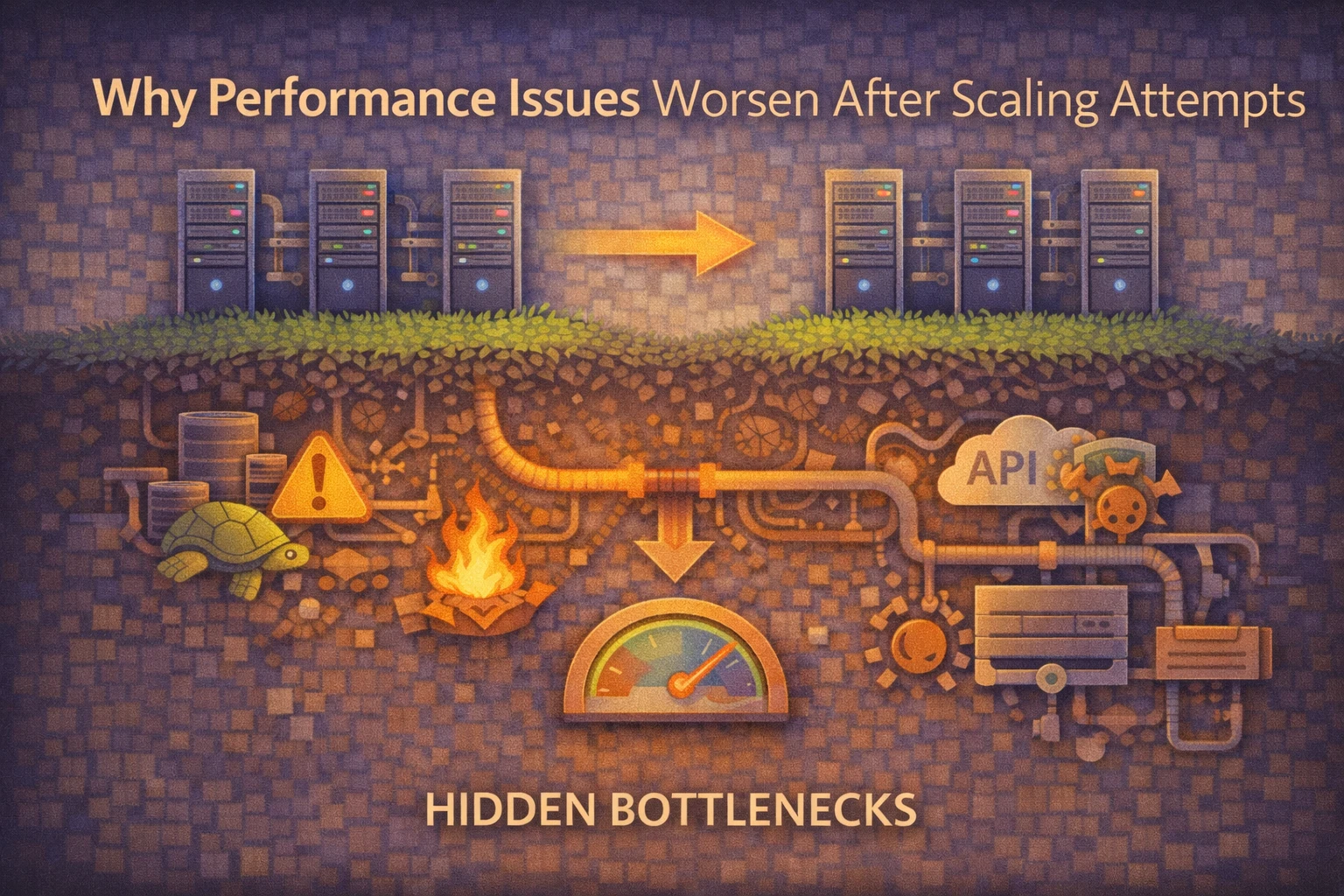
Scaling is commonly viewed as a performance solution.
When systems slow down, the default reaction is predictable: add more servers, increase CPU, allocate more memory, or upgrade infrastructure. Because this approach feels logical, deeper analysis is often skipped.
However, scaling frequently worsens performance problems rather than fixing them.
At Wisegigs.eu, many infrastructure investigations begin after a scaling attempt fails to deliver expected improvements. In some cases, latency increases, instability appears, or resource usage becomes even less predictable.
This article explains why scaling can amplify existing issues, how hidden bottlenecks distort outcomes, and what disciplined teams evaluate before expanding capacity.
Scaling Does Not Remove Structural Bottlenecks
Scaling increases available resources.
It does not automatically eliminate the constraints that caused performance problems in the first place. When bottlenecks are architectural rather than capacity-driven, additional hardware simply magnifies inefficiency.
For example, inefficient queries, blocking operations, or poorly designed dependencies continue to behave the same way — only at larger scale.
Without identifying the limiting factor, scaling becomes a multiplier, not a solution.
Latency Often Moves Instead of Disappearing
Performance issues rarely vanish after scaling.
Instead, they relocate.
Adding servers may reduce CPU pressure while exposing database contention. Increasing memory may reduce swapping while revealing locking behavior. Expanding infrastructure often shifts the bottleneck to another layer.
As a result, teams observe changing symptoms without understanding root causes.
Google’s performance analysis guidance emphasizes diagnosing constraints before optimization:
https://sre.google/sre-book/
Without that discipline, scaling produces confusing results.
Coordination Overhead Increases With Complexity
Distributed systems introduce coordination costs.
Additional servers require synchronization, state management, cache consistency, and network communication. Consequently, systems that previously ran on a single node now depend on multiple components behaving correctly.
When scaling occurs without architectural readiness, coordination overhead introduces new delays.
More resources can therefore produce slower response times.
Database Bottlenecks Become More Severe
Databases frequently limit scalability.
When application instances multiply, query volume increases rapidly. Even small inefficiencies become significant under higher concurrency.
Scaling frontend or application layers without addressing database constraints often intensifies latency rather than reducing it.
The PostgreSQL documentation, for instance, highlights how concurrency and locking behavior affect performance:
https://www.postgresql.org/docs/current/
Databases scale differently than stateless services.
Caching Behavior Changes Under Scale
Caching strategies behave differently at higher load.
Cache invalidation, eviction policies, and synchronization issues emerge only when traffic patterns intensify. As a result, systems that appeared efficient under moderate usage begin to show inconsistent behavior.
Without careful validation, scaling can degrade cache effectiveness instead of improving performance.
This often surprises teams who expected immediate gains.
Third-Party Dependencies Become Critical Risks
Scaling increases reliance on external services.
APIs, authentication providers, analytics platforms, and monitoring systems all receive more requests. Consequently, latency or rate limits in these services become more visible.
Under scale, external dependencies often become dominant bottlenecks.
Google’s web performance documentation warns about dependency-induced delays:
https://web.dev/fast/
Scaling cannot compensate for slow upstream systems.
Resource Contention May Increase Instead of Decrease
More infrastructure does not guarantee more stability.
Improper load balancing, uneven request distribution, or shared resource contention can create hotspots. In such cases, scaling intensifies unpredictability.
Instead of distributing load, systems may concentrate pressure on specific components.
This behavior explains why scaling sometimes correlates with worse performance.
Why Scaling Feels Like It Should Work
Scaling appeals because it is tangible.
Hardware upgrades are visible. Metrics change immediately. Actions feel decisive. Unfortunately, visible change does not guarantee meaningful improvement.
Without identifying constraints, scaling becomes trial-and-error rather than engineering.
Disciplined teams treat scaling as a controlled experiment, not an automatic fix.
What Reliable Scaling Strategy Looks Like
Effective scaling begins with diagnosis.
Resilient teams:
Identify true bottlenecks
Measure system behavior under load
Validate database capacity separately
Evaluate coordination costs
Test caching assumptions
Monitor dependency latency
At Wisegigs.eu, scaling decisions are guided by system behavior rather than intuition.
This approach prevents performance regressions after expansion.
Conclusion
Scaling does not inherently improve performance.
In many cases, it amplifies unresolved issues.
To recap:
Structural bottlenecks survive scaling
Latency often shifts layers
Coordination overhead increases
Databases limit growth differently
Caching behavior changes
Dependencies become critical risks
Resource contention may intensify
At Wisegigs.eu, stable infrastructure growth depends on constraint analysis rather than resource expansion alone.
If performance worsens after scaling, the problem is rarely capacity.
It is usually design.
Contact Wisegigs.eu