
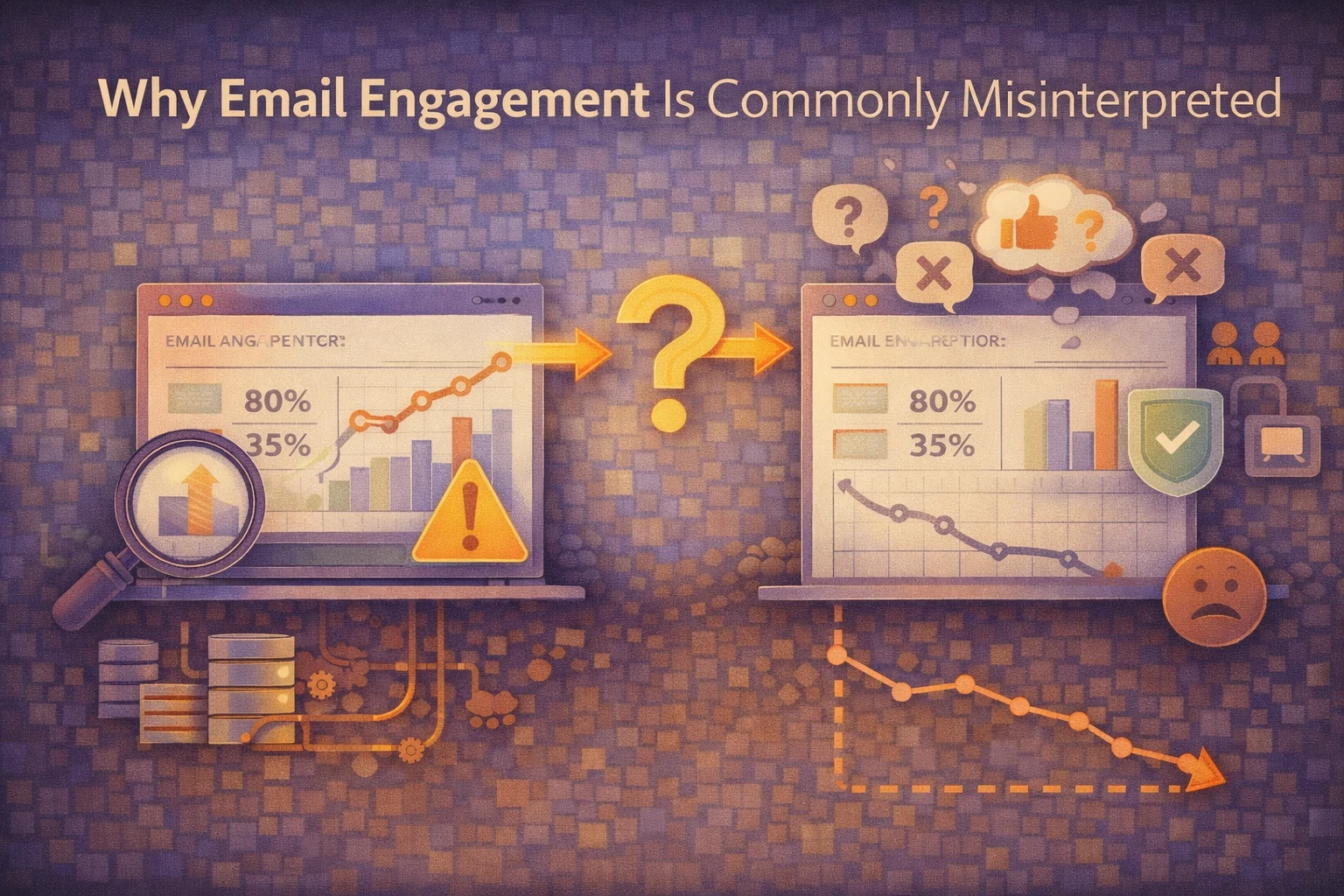
Email metrics appear deceptively simple.
Open rates, click rates, and conversions are presented as clear indicators of success. Because of this, teams often assume that engagement data directly reflects user interest and campaign effectiveness.
In practice, these assumptions frequently fail.
At Wisegigs.eu, many email performance investigations reveal a recurring pattern: the data is accurate, yet the interpretation is flawed. When metrics are treated as conclusions rather than signals, decision-making becomes distorted.
This article explains why email engagement is often misunderstood, how misleading interpretations emerge, and what reliable analysis actually requires.
High Engagement Does Not Guarantee High Intent
Strong engagement metrics feel reassuring.
A campaign with high opens and clicks appears successful at first glance. However, interaction alone does not confirm intent, satisfaction, or conversion readiness.
Users may open emails out of habit, curiosity, or even confusion. Similarly, clicks may reflect navigation attempts rather than genuine interest.
Without contextual analysis, engagement metrics risk becoming vanity indicators instead of meaningful signals.
Open Rates Are Technically Fragile
Open tracking depends on external factors.
Most platforms rely on tracking pixels, which are affected by image blocking, privacy features, and client-side behavior. As a result, open rates often reflect technical conditions rather than user decisions.
Apple’s Mail Privacy Protection, for example, significantly altered how opens are recorded:
https://support.apple.com/en-us/HT212797
Consequently, comparing historical open rates without accounting for these changes leads to incorrect conclusions.
Click Behavior Can Be Misleading
Clicks appear more reliable than opens.
Even so, click data can still produce misleading narratives. Users often click links to scan content, verify relevance, or recover context rather than to initiate action.
In some cases, poorly structured emails inflate clicks because recipients search for missing information. Under those conditions, higher interaction may actually signal friction instead of effectiveness.
Meaningful interpretation requires examining post-click behavior, not just click counts.
Engagement Metrics Ignore Silent Dissatisfaction
Not all negative signals are visible.
Disengaged users frequently ignore emails without unsubscribing. Others filter messages, mentally dismiss content, or gradually lose interest.
Because these behaviors produce limited measurable events, dashboards often hide early warning signs. Over time, this creates a false sense of stability.
Declining attention rarely triggers dramatic metrics. Instead, it erodes performance quietly.
Conversions Depend on More Than Email Interaction
Email engagement does not operate in isolation.
Landing page clarity, site performance, offer structure, and user expectations all influence outcomes. Therefore, strong engagement combined with weak conversions typically indicates downstream issues rather than email failure.
Teams that attribute poor results solely to subject lines or design often overlook structural bottlenecks elsewhere.
Reliable analysis connects email data to the full user journey.
Averages Hide Behavioral Segments
Aggregate metrics conceal variation.
A campaign may show healthy average engagement while masking drastically different user segments. Highly active subscribers, passive readers, and disengaged recipients all blend into the same numbers.
Without segmentation, interpretation becomes dangerously simplistic.
Behavior-driven evaluation reveals patterns that averages cannot expose.
Engagement Often Reflects Expectation, Not Value
Users respond based on expectations.
Frequent senders, recognizable brands, and familiar formats can produce consistent engagement regardless of content quality. In these cases, interaction reflects routine rather than perceived value.
When teams equate engagement stability with strategy success, stagnation often follows.
True performance evaluation requires distinguishing habit from impact.
What Reliable Email Analysis Looks Like
Effective teams treat engagement metrics as signals.
Instead of drawing immediate conclusions, they:
Examine trends over time
Validate tracking assumptions
Segment behavioral patterns
Correlate engagement with outcomes
Investigate anomalies cautiously
At Wisegigs.eu, email analytics is framed as a diagnostic tool rather than a scoreboard.
This mindset reduces false confidence and improves strategic decisions.
Conclusion
Email engagement metrics are not inherently misleading.
Misinterpretation creates the problem.
To recap:
High engagement does not confirm intent
Open rates depend on technical conditions
Clicks may signal friction
Silent disengagement often goes unnoticed
Conversions rely on broader systems
Averages hide behavioral differences
At Wisegigs.eu, reliable email strategy depends on interpretation discipline rather than raw metrics.
If your campaigns show healthy engagement but inconsistent results, the issue may not be performance — but perception.
Contact Wisegigs.eu