
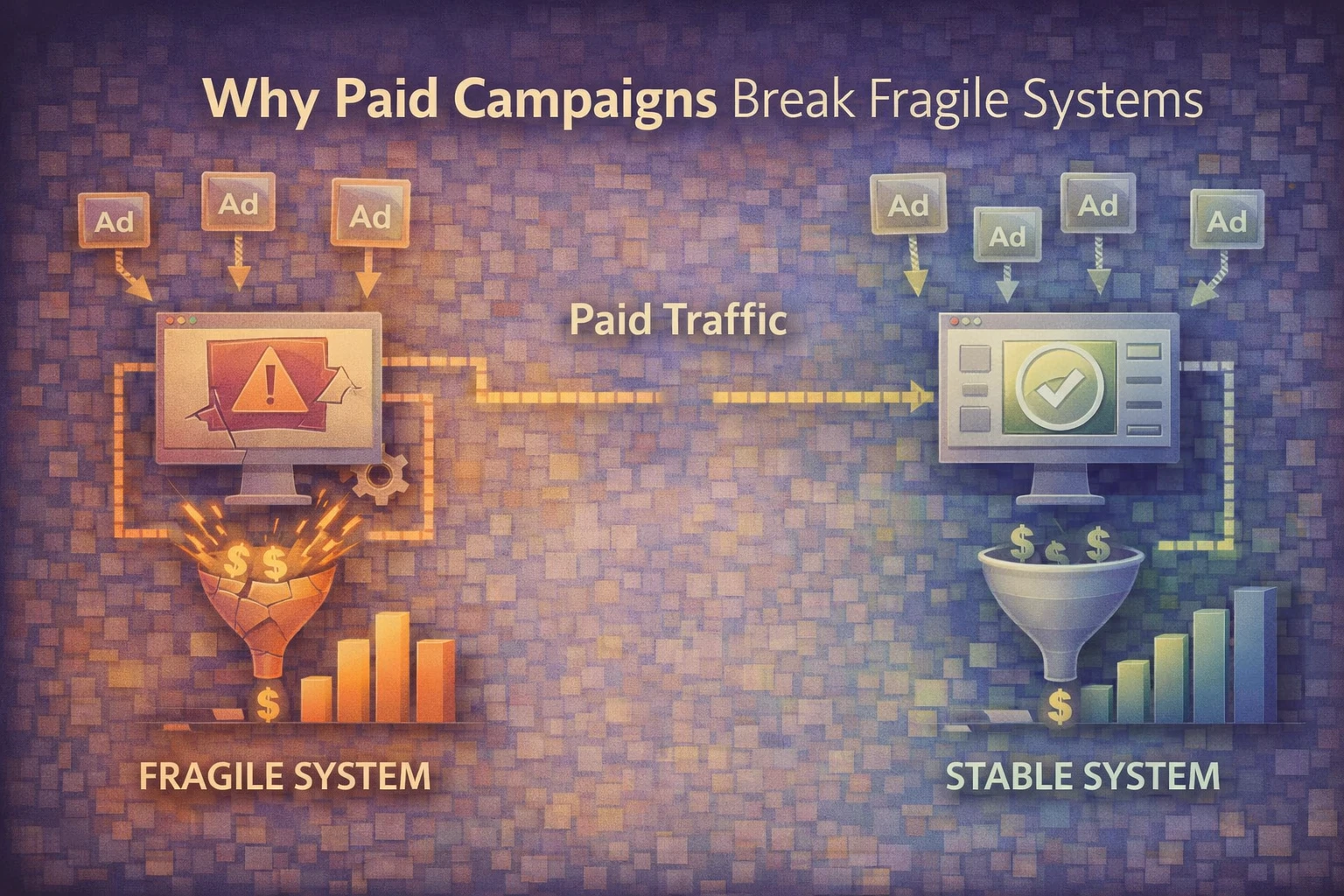
Paid campaigns do not fail quietly.
When paid traffic goes live, systems face immediate pressure. Traffic spikes arrive without warning, user behavior changes suddenly, and edge cases appear at scale. Because of this, weaknesses that remained invisible under organic traffic surface fast.
At Wisegigs.eu, most paid media failures we analyze do not start with ads, targeting, or creatives. Instead, paid campaigns expose structural fragility that already existed.
This article explains why paid campaigns break fragile systems, what types of weaknesses they reveal, and how resilient teams prepare before increasing spend.
Paid Traffic Behaves Differently From Organic Traffic
Paid traffic does not follow familiar paths.
Instead, users arriving from ads often:
Enter deep into funnels
Skip context and navigation
Move quickly
Abandon faster
Trigger edge cases
As a result, paid campaigns stress assumptions built into site structure, performance, analytics, and UX.
Google explicitly highlights that landing page experience becomes critical under paid traffic:
https://support.google.com/google-ads/answer/6368675
When systems rely on assumptions rather than structure, paid traffic exposes the gap.
Traffic Spikes Reveal Performance Weaknesses
Unlike organic growth, paid traffic does not ramp gradually.
Once campaigns start, servers, caches, databases, and third-party services feel the load immediately. Consequently, fragile systems begin to show cracks.
Common symptoms include:
Slow page loads
Timeouts
Broken scripts
Failed API calls
Missing analytics events
These failures rarely come from ads themselves. Instead, they reveal infrastructure that was never tested under real stress.
Performance problems that stay hidden at low volume surface within minutes of a paid launch.
Funnels Collapse When Assumptions Fail
Many funnels are built around internal expectations.
Teams assume users:
Start on the homepage
Understand the offer immediately
Follow linear steps
Behave patiently
Paid traffic breaks these assumptions.
When users enter mid-funnel or skip context, fragile funnels fall apart. As a result, conversion rates drop and teams blame campaigns rather than structure.
UX research consistently shows that user behavior rarely matches internal mental models:
https://www.nngroup.com/articles/mental-models/
Paid traffic simply reveals this mismatch faster.
Tracking Problems Become Impossible to Ignore
Under low traffic, tracking issues often stay hidden.
Once paid campaigns launch, however, missing or broken tracking becomes obvious. Events fail to fire, attribution breaks, and conversion data becomes unreliable.
This usually happens because of:
Inconsistent event definitions
Client-side tracking under load
Script timing issues
Consent and tag sequencing problems
Without reliable tracking, teams lose visibility precisely when decisions matter most.
Analytics systems must withstand stress, not just function during calm conditions.
Third-Party Dependencies Turn Into Bottlenecks
Paid campaigns increase reliance on external services.
Analytics tools, tag managers, CRMs, consent tools, and payment providers all become critical paths. Unfortunately, fragile systems fail at these integration points.
A slow or blocked third-party script can delay rendering, break tracking, or prevent conve
rsions entirely.
Google’s web performance guidance warns about the risks of heavy third-party dependencies:
https://www.analyticsmania.com/post/google-ads-conversion-tracking-not-working/
Paid traffic amplifies these risks instantly.
Why Paid Media Does Not Create Problems
Instead, paid media reveals problems.
When teams pause campaigns after failures, the underlying weaknesses remain. As a result, the same issues resurface during promotions, launches, or seasonal spikes.
In this sense, paid campaigns act as stress tests for systems.
Resilient teams treat paid traffic as a diagnostic signal rather than a threat.
What Resilient Systems Do Differently
Teams that scale paid media successfully prepare first.
They:
Validate performance under load
Simplify funnels and entry points
Align analytics with intent
Reduce third-party dependencies
Test assumptions with real users
At Wisegigs, paid campaigns are treated as system-level tests. Infrastructure, UX, analytics, and messaging are evaluated together instead of in isolation.
This approach turns paid media into a learning tool rather than a failure trigger.
Conclusion
Paid campaigns do not break healthy systems.
They break fragile ones.
To recap:
Paid traffic behaves differently
Traffic spikes expose performance limits
Funnels collapse when assumptions fail
Tracking gaps surface immediately
Third-party dependencies become bottlenecks
At Wisegigs.eu, the most successful paid campaigns run on systems designed to absorb pressure, not avoid it.
If paid traffic keeps “breaking” your site, the real issue may not be your ads — but the structure beneath them.
Contact Wisegigs.eu