
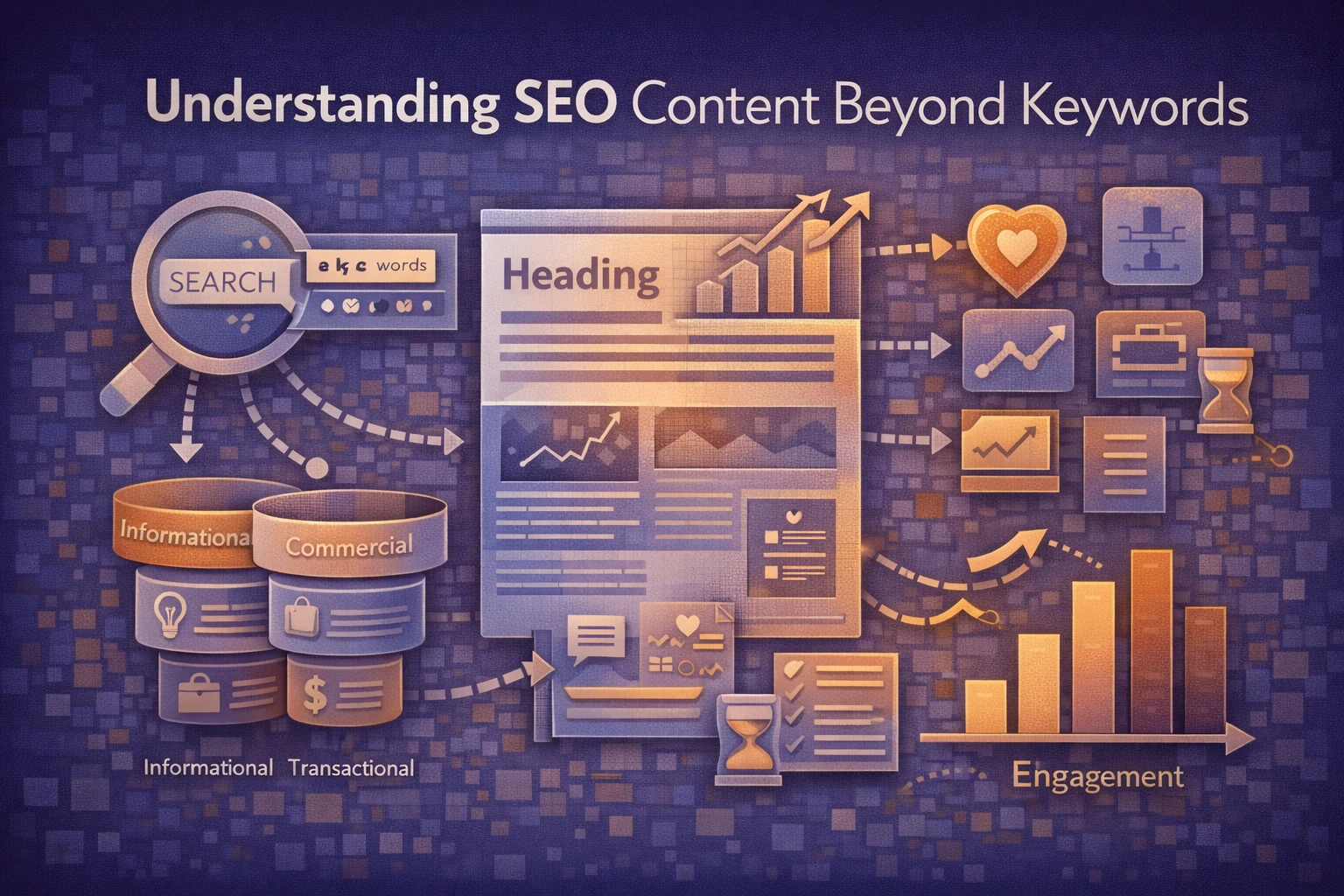
For years, SEO content strategy revolved around keywords.
Find the right phrase.
Use it in the title.
Repeat it throughout the page.
Publish and wait.
That approach no longer works on its own.
At Wisegigs.eu, many SEO issues we diagnose are not caused by missing keywords. Instead, they come from content that technically targets search terms but fails to satisfy search intent, clarity, and usefulness.
This article explains why SEO content must go beyond keywords, what modern search engines actually evaluate, and how content strategy should be approached today.
Keywords Are Signals, Not Strategy
Keywords still matter.
However, they are only signals, not the foundation of SEO success.
Search engines use keywords to understand topic relevance. What they evaluate next is far more important:
Does the content answer the query clearly?
Does it satisfy user intent?
Does it provide depth or insight?
Does it help the user make a decision?
A page can rank briefly with keyword targeting alone. It rarely sustains visibility without meeting these broader expectations.
Google’s Search Central documentation emphasizes that content should be created for users first, not search engines:
https://developers.google.com/search/docs/fundamentals/creating-helpful-content
Search Intent Shapes Content More Than Keywords
Modern SEO starts with intent.
The same keyword can represent very different needs:
Informational (learning)
Navigational (finding)
Commercial (comparing)
Transactional (buying)
Content that ignores intent often ranks poorly or converts badly.
For example, informational content written for transactional keywords creates friction. Users arrive, realize the page does not match their goal, and leave.
As a result, engagement drops and rankings follow.
Search engines increasingly measure satisfaction signals, not just relevance.
Structure and Clarity Influence Rankings Indirectly
Content quality is not only about what is written, but how it is presented.
SEO-friendly content typically includes:
Clear headings
Logical section flow
Concise explanations
Scannable formatting
Defined takeaways
These elements improve readability and comprehension.
Better comprehension leads to better engagement. Better engagement supports long-term ranking stability.
Google’s UX guidance highlights clarity and usability as indirect ranking factors:
https://web.dev/user-centric-performance/
SEO content must be readable before it can be valuable.
Depth Matters More Than Density
Keyword density used to be a ranking tactic.
Today, depth is far more important.
High-performing SEO content tends to:
Cover a topic comprehensively
Address related questions
Anticipate follow-up concerns
Provide context and examples
This is why long-form, well-structured content often outperforms shorter keyword-focused pages.
Search engines are designed to surface content that demonstrates understanding, not repetition.
Content Must Support the User Journey
SEO content rarely exists in isolation.
Each piece should support a broader journey:
Awareness
Consideration
Decision
Trust
When content fails to connect to the next step, traffic becomes unproductive.
At Wisegigs, SEO content is designed to:
Educate first
Clarify complexity
Reduce uncertainty
Guide users toward relevant next actions
This alignment improves both rankings and conversions.
Measuring SEO Success Requires More Than Rankings
Ranking improvements feel good.
However, rankings alone do not define success.
Healthy SEO content performance is measured by:
Engagement
Time on page
Scroll depth
Reminder traffic
Assisted conversions
Analytics platforms consistently show that pages ranking well but failing to engage users tend to lose visibility over time.
SEO content should be evaluated as part of a system, not as isolated URLs.
What Effective SEO Content Looks Like Today
Strong SEO content shares common characteristics:
Clear intent alignment
Topic depth instead of keyword stuffing
Logical structure and flow
Human-readable language
Supporting internal links
Clear next steps for users
Keywords support these elements. They do not replace them.
At Wisegigs.eu, SEO content is treated as long-term digital infrastructure, not a publishing checklist.
Conclusion
SEO content is no longer about inserting the right keywords.
It is about understanding what users are trying to accomplish and delivering content that genuinely helps them do it.
Keywords still matter, but they are only the starting point.
Sustainable SEO performance comes from:
Intent-driven content
Clear structure
Depth and relevance
Measurable engagement
At Wisegigs.eu, we help businesses build SEO content strategies that go beyond keywords and deliver lasting visibility.
If your content ranks but fails to perform, the issue may not be keywords.
Contact Wisegigs.eu