
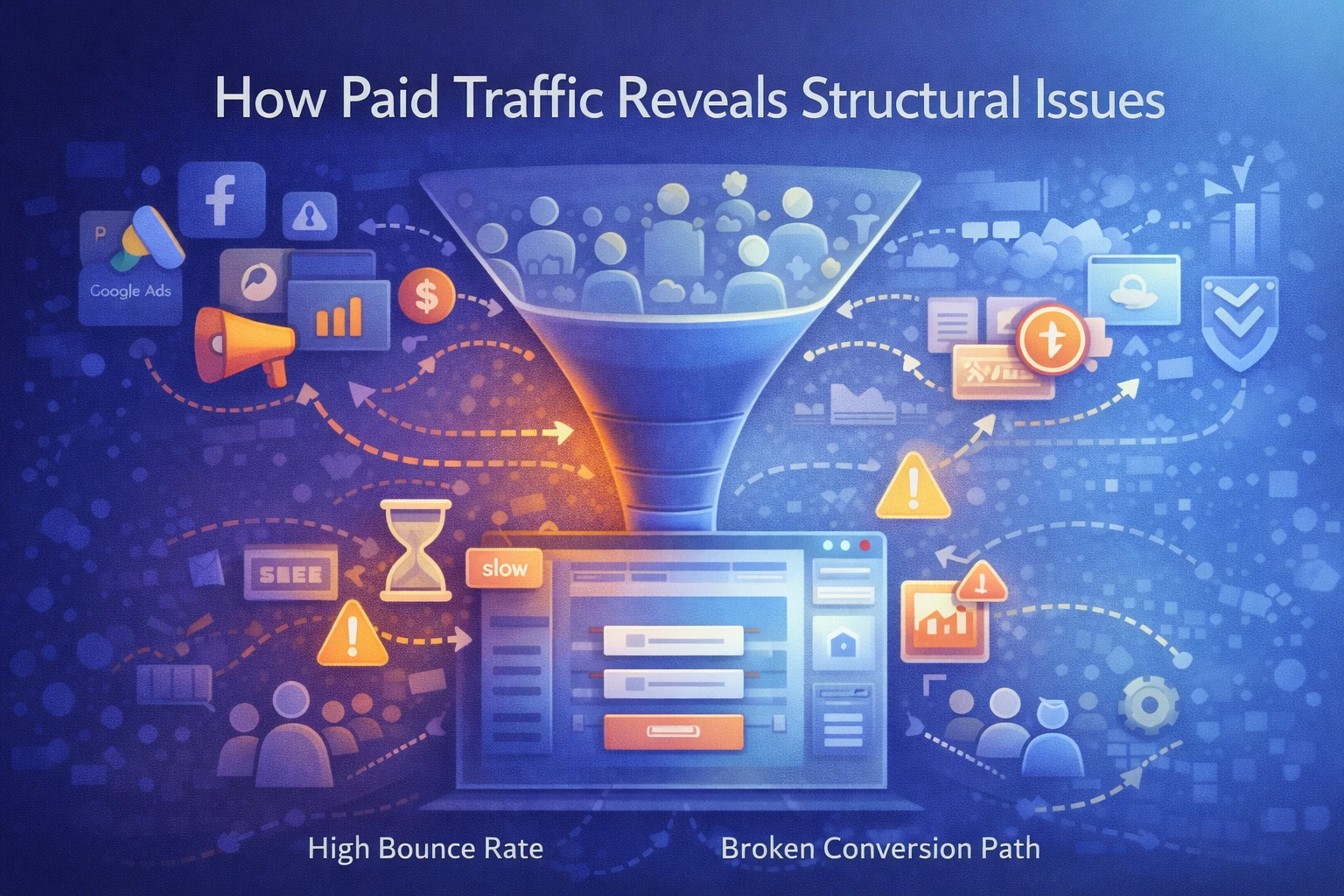
Paid traffic is often treated as a growth lever.
Increase ad spend.
Drive more clicks.
Expect more conversions.
When results fall short, the campaign is blamed.
At Wisegigs, we repeatedly see a different pattern. Paid campaigns don’t usually fail because of targeting or budget alone. They fail because paid traffic exposes problems that already existed.
This article explains how paid traffic acts as a stress test for websites, why issues surface faster with ads than organic traffic, and what those failures reveal about underlying structure.
1. Paid Traffic Removes the Margin for Error
Organic traffic is forgiving.
Users arrive gradually.
They explore at their own pace.
They tolerate friction.
Paid traffic is different.
Visitors arrive with:
Clear intent
Limited patience
High expectations
Any friction becomes immediately visible.
Slow load times, unclear messaging, weak trust signals, and confusing layouts are tolerated less when users arrive from ads. Paid traffic doesn’t create these problems — it magnifies them.
Google’s advertising guidance consistently highlights that landing page experience directly affects campaign performance:
https://support.google.com/google-ads/answer/2404197
2. Conversion Funnels Break Under Pressure
Many funnels appear functional under low traffic.
Forms submit.
Pages load.
Analytics fire.
Paid campaigns introduce volume and consistency. Under that pressure, weak funnels reveal themselves through:
High bounce rates
Drop-offs mid-journey
Form abandonment
Poor mobile performance
These issues often existed before ads launched. Paid traffic simply accelerates exposure.
This is why paid media is often the first place teams notice structural problems.
3. Performance Problems Become Impossible to Ignore
Performance issues are subtle with organic traffic.
With paid traffic, they are costly.
Every extra second of load time:
Increases bounce rate
Reduces Quality Score
Raises cost per click
Lowers conversion rate
Google’s research shows that slower pages significantly reduce conversion probability, especially for mobile users:
https://web.dev/rail/
Paid traffic turns performance from a technical concern into a direct budget issue.
4. Messaging Gaps Surface Immediately
Organic visitors often arrive after research.
Paid visitors often arrive cold.
This makes messaging critical.
Paid traffic quickly reveals:
Unclear value propositions
Mismatch between ad promise and page content
Weak calls to action
Overly generic landing pages
If users don’t understand why they should act within seconds, they leave.
This is not a media problem.
It is a structural communication problem.
5. Tracking Weaknesses Become Expensive
Paid campaigns depend on accurate tracking.
Structural tracking issues include:
Missing or broken conversion events
Incorrect attribution
Incomplete funnel visibility
Cookie or consent misconfiguration
When tracking is flawed, teams optimize blindly.
Google Tag Manager documentation emphasizes that reliable measurement is foundational to paid media optimization:
https://developers.google.com/tag-platform/tag-manager
Paid traffic doesn’t tolerate guesswork. Every unknown becomes wasted spend.
6. Paid Traffic Exposes Assumptions
Many websites are built on assumptions:
Users will scroll
Users will understand
Users will explore
Users will return
Paid traffic challenges these assumptions.
When visitors leave immediately, it’s not because they are the “wrong audience.”
It’s often because the site relies on behaviors that do not scale.
Paid traffic reveals whether your site works for real users under real conditions.
7. What Healthy Sites Do Differently
Websites that perform well with paid traffic share common traits:
Clear page purpose
Fast, predictable performance
Strong alignment between ads and landing pages
Minimal friction in conversion paths
Reliable tracking and attribution
Paid traffic becomes efficient only when the underlying structure is sound.
At Wisegigs, we treat paid campaigns as diagnostic tools, not just acquisition channels.
Conclusion
Paid traffic doesn’t break websites.
It reveals what was already broken.
Ads amplify load, intent, and expectations. Under that pressure, structural weaknesses surface quickly — in performance, messaging, tracking, and funnel design.
Instead of blaming campaigns, teams should use paid traffic as a signal.
At Wisegigs.eu, we help businesses fix the structural issues that paid media exposes — so ad spend turns into growth, not wasted budget.
If your paid campaigns drive traffic but not results, the issue may not be the ads.
Contact Wisegigs.eu