
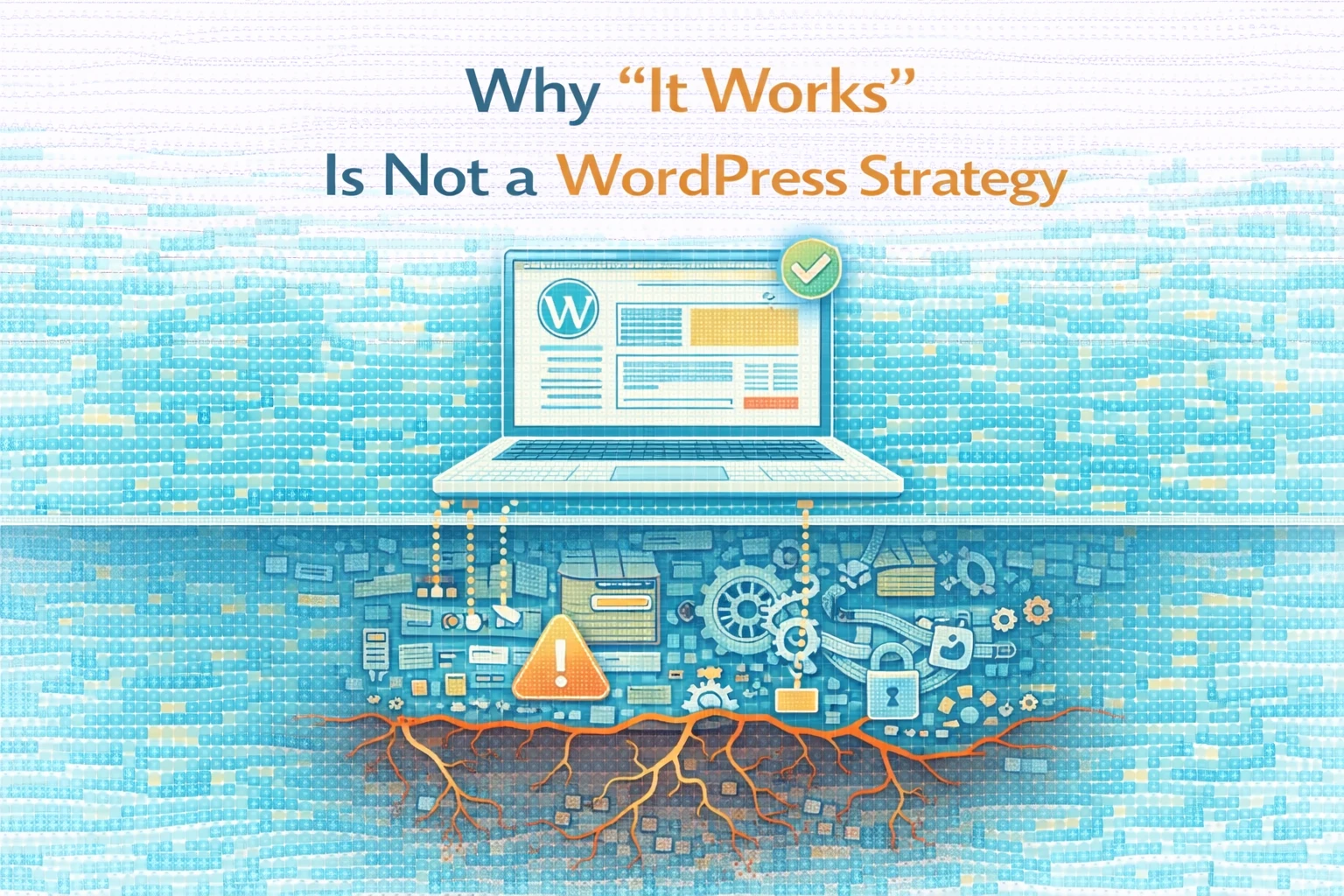
“It works” is the most common justification in WordPress development.
The site loads. Pages render. Clients can publish content. From the outside, everything appears fine. As a result, development decisions are rarely questioned as long as nothing is visibly broken.
At Wisegigs.eu, many WordPress failures begin exactly this way. Systems that “work” today quietly accumulate risk that surfaces later as outages, slowdowns, failed updates, or unmaintainable codebases.
This article explains why “it works” is not a strategy, how that mindset creates long-term problems in WordPress development, and what disciplined teams do instead.
1. “It Works” Optimizes for the Present Only
When teams accept “it works” as success, they optimize for immediate output.
This mindset prioritizes:
Short-term delivery
Visual correctness
Minimal effort
It ignores:
Future changes
Scaling behavior
Maintenance cost
WordPress systems rarely stay static. Plugins update. Traffic grows. Requirements change. Code that works today often fails under new conditions.
Software engineering research consistently shows that short-term optimization increases long-term maintenance burden:
https://martinfowler.com/articles/designDead.html
WordPress is not immune to this effect.
2. Working Code Can Still Be Fragile
Functional does not mean resilient.
Many WordPress implementations “work” while hiding fragility:
Tight coupling between themes and plugins
Hardcoded assumptions about data
Global state dependencies
Unscoped hooks and filters
These systems fail when:
A plugin updates
Execution order changes
An edge case appears
Traffic increases
WordPress core documentation stresses using stable APIs to avoid fragile behavior:
https://developer.wordpress.org/apis/
Ignoring those APIs creates systems that work until they don’t.
3. “It Works” Masks Technical Debt
Technical debt rarely announces itself.
In WordPress, it hides behind:
Custom snippets added over time
Untracked overrides
Workarounds layered on workarounds
Child themes filled with logic
As long as the site loads, debt accumulates unnoticed.
Eventually:
Updates become risky
Bugs take longer to fix
Developers avoid touching the system
At Wisegigs.eu, many WordPress audits reveal sites that function well but are effectively frozen due to fear of change.
4. Maintenance Is Treated as an Afterthought
“It works” rarely includes maintainability.
WordPress projects often lack:
Code ownership
Documentation
Naming consistency
Clear separation of concerns
This creates dependency on specific individuals.
When teams change, knowledge disappears. The site still works, but no one understands why.
The WordPress Plugin Handbook explicitly recommends structured, documented development for long-term stability:
https://developer.wordpress.org/plugins/
Maintenance problems surface long after launch.
5. Updates Become a Source of Fear
Healthy WordPress systems tolerate updates.
Fragile ones break.
When “it works” guides development:
Plugins are pinned indefinitely
Core updates are delayed
Security patches are postponed
Over time, risk compounds.
WordPress maintains strong backward compatibility, but it cannot protect systems built on undocumented behavior or unsafe overrides.
Updates expose what “it works” has been hiding.
6. Performance Problems Appear Late
Performance rarely fails immediately.
Systems that “work” under low traffic often include:
Inefficient queries
Uncached operations
Blocking external requests
Overloaded hooks
As usage grows, these issues surface.
Google’s web performance guidance emphasizes measuring real-world behavior, not assumptions:
https://web.dev/measure/
By the time performance issues appear, architectural changes are harder and more expensive.
7. Ownership and Accountability Are Unclear
“It works” often means no one owns the system.
Responsibilities are vague:
Who reviews code changes?
Who approves new plugins?
Who maintains custom logic?
Without ownership, quality degrades.
At Wisegigs.eu, the most stable WordPress systems have clear technical ownership — even when built by small teams.
8. Strategy Requires Intentional Trade-Offs
A strategy implies conscious decisions.
“It works” avoids trade-offs.
Good WordPress strategy answers questions such as:
Where does custom code belong?
What is allowed in themes vs plugins?
How is performance validated?
How are changes reviewed?
Without answers, systems evolve randomly.
Engineering discipline matters more than tooling.
What a Real WordPress Strategy Looks Like
Sustainable WordPress development replaces “it works” with intent:
Use WordPress APIs consistently
Separate presentation from logic
Treat custom code as production software
Document decisions and ownership
Test assumptions regularly
Design for change, not just launch
WordPress works best when treated as a system, not a shortcut.
Conclusion
“It works” describes a moment, not a strategy.
WordPress sites fail not because they never worked, but because they were never designed to keep working.
To recap:
Working code can still be fragile
Technical debt hides behind functionality
Maintenance is often ignored
Updates expose weak assumptions
Performance issues surface late
Ownership gaps increase risk
Strategy requires intentional decisions
At Wisegigs.eu, long-lived WordPress systems are built with maintainability in mind from the start.
If your WordPress site works today but feels risky to touch, the problem is not WordPress.
It is the absence of strategy.
Need help turning “it works” into a sustainable WordPress system? Contact wisegigs.eu