
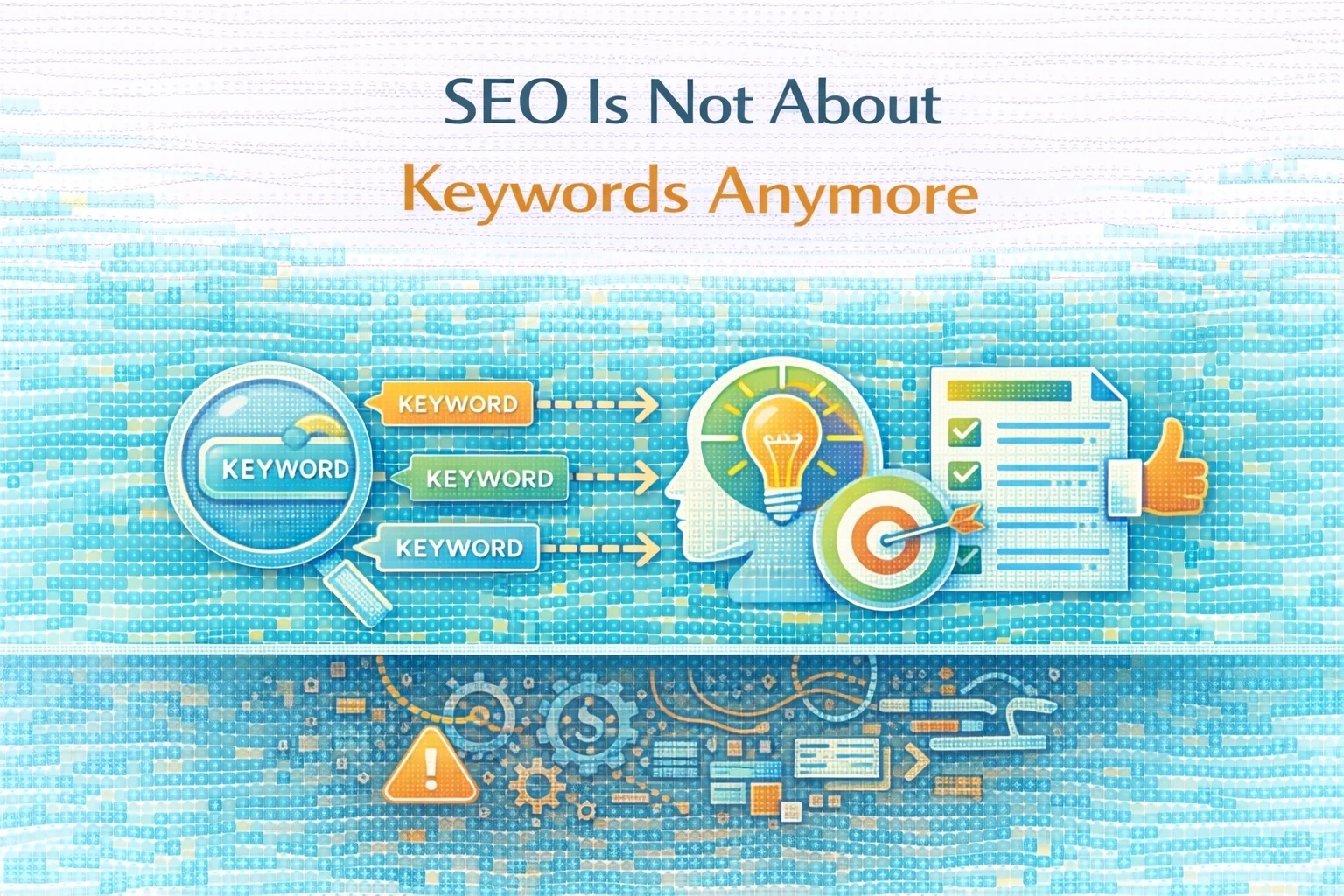
For years, SEO strategy started with keywords.
Teams researched volumes, mapped terms to pages, and optimized headings and copy around exact phrases. That approach worked when search engines relied heavily on lexical matching.
That era is over.
At Wisegigs.eu, SEO performance problems today rarely come from missing keywords. They come from misunderstanding what search engines now evaluate instead.
This article explains why SEO is no longer about keywords, what has replaced them as the primary ranking drivers, and how teams should adapt their content strategy accordingly.
1. Search Engines Optimize for Understanding, Not Matching
Modern search engines no longer rely on simple keyword matching.
They aim to understand:
User intent
Topic relevance
Contextual relationships
Content usefulness
This shift means pages can rank without repeating exact phrases, while keyword-stuffed pages quietly lose visibility.
Google’s Search Central documentation makes it clear that content should be written for people, not keyword formulas:
https://developers.google.com/search/docs/fundamentals/creating-helpful-content
SEO fails when teams optimize language instead of meaning.
2. Keyword Optimization Often Misses Search Intent
Keywords describe queries.
They do not explain why users search.
Two people can search the same term with different intent:
Research
Comparison
Purchase
Troubleshooting
Keyword-focused content often:
Answers the wrong question
Targets the wrong funnel stage
Creates high bounce rates
Search intent alignment is now a stronger ranking signal than keyword density.
Ahrefs’ intent research shows that intent mismatch is a primary cause of ranking stagnation:
https://ahrefs.com/blog/search-intent/
SEO performance drops when keywords are treated as goals instead of signals.
3. Topical Coverage Matters More Than Individual Pages
Search engines evaluate authority at the topic level.
This means:
Single optimized pages are less effective
Thin content clusters struggle to rank
Gaps in coverage reduce trust
Keyword-first strategies produce disconnected pages. Topic-first strategies build coherent coverage.
Google’s guidance on site-wide quality signals emphasizes consistency and depth across related content:
https://developers.google.com/search/docs/appearance/site-names
SEO improves when content is designed as a system, not a list of targets.
4. User Engagement Signals Influence Visibility
Keywords do not reflect satisfaction.
Search engines observe behavior such as:
Click-through patterns
Time on page
Return-to-search behavior
Long-term engagement
Content that ranks but fails users tends to decline over time.
5. Content Quality Is Evaluated Holistically
Search engines evaluate pages using multiple dimensions:
Expertise
Clarity
Structure
Originality
Trust signals
Keyword placement is only a minor input.
Low-effort content optimized for terms but lacking insight is increasingly filtered out.
6. SEO Maintenance Matters More Than Initial Optimization
Keyword strategies assume static content.
Search reality is dynamic:
Competitors update content
Search intent evolves
Algorithms refine evaluation
Pages optimized once and ignored gradually lose relevance.
SEO success now depends on:
Regular content review
Updating outdated assumptions
Improving coverage depth
SEO fails when content is published and forgotten.
7. Internal Structure Signals Matter More Than Keywords
How content is connected influences understanding.
Search engines use:
Internal linking
Hierarchical structure
Contextual relevance
Keyword-optimized pages without structural support struggle to rank.
Content architecture now plays a larger role than individual phrase usage.
SEO visibility improves when structure reinforces meaning.
8. Keywords Still Matter — Just Not the Way Teams Expect
Keywords are not irrelevant.
They still help with:
Discovering demand
Understanding language patterns
Validating intent
But they are inputs, not objectives.
At Wisegigs.eu, effective SEO strategies use keywords to inform content decisions, not dictate them.
What SEO Strategy Looks Like Without Keyword Obsession
Modern SEO focuses on:
Search intent clarity
Topic-level coverage
Content usefulness
Engagement signals
Structural consistency
Ongoing maintenance
Keywords support these goals. They do not replace them.
Conclusion
SEO did not become harder.
It became more honest.
To recap:
Search engines optimize for understanding
Intent matters more than phrasing
Topics outperform isolated pages
Engagement influences rankings
Quality is evaluated holistically
Maintenance prevents decay
Structure reinforces relevance
At Wisegigs.eu, SEO works best when content is built to help users, not satisfy formulas.
If your SEO strategy still starts and ends with keywords, performance will quietly decline — even if rankings look stable today.
Need help realigning your SEO and content strategy for how search actually works now? Contact wisegigs.eu