
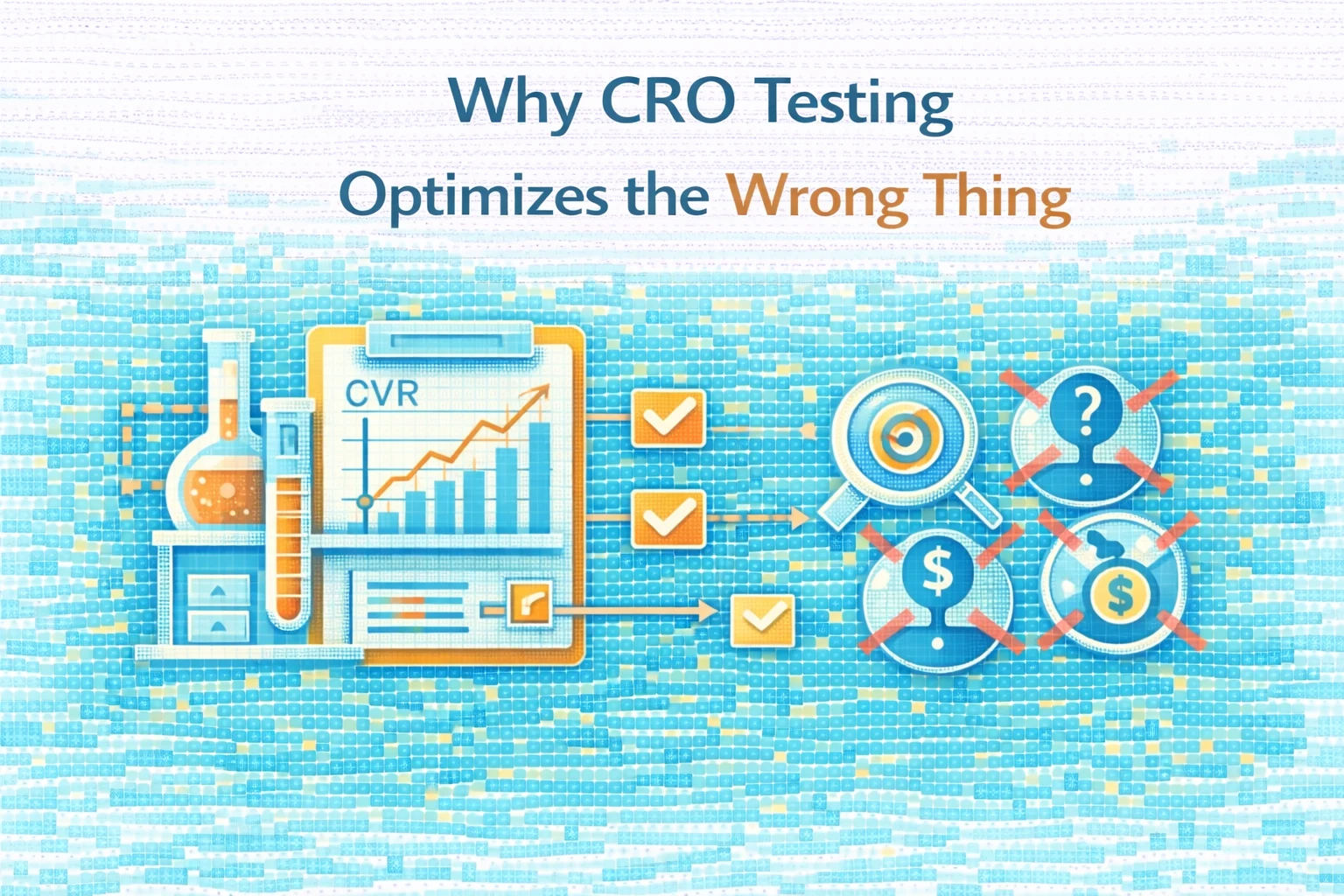
Conversion rate optimization is supposed to reduce uncertainty.
Teams run tests, measure outcomes, and expect clearer decisions. Yet many CRO programs generate confident conclusions that fail to improve real business performance. Conversion rates move, but revenue, retention, and long-term growth do not.
At Wisegigs.eu, this pattern shows up repeatedly. The issue is rarely testing discipline or tooling. The issue is what CRO testing is actually optimizing.
This article explains why CRO testing often targets the wrong outcomes, how that misalignment happens, and how to design experiments that improve real performance instead of surface metrics.
1. CRO Tests Optimize What Is Easy to Measure
Most CRO tests focus on metrics that are simple to observe.
Typical examples include:
Click-through rate
Form completion
Button interaction
Page-level conversion
These metrics are visible, fast, and statistically convenient. However, they are rarely the true constraint in the user journey.
As a result, teams optimize micro-actions that do not meaningfully change user outcomes.
Usability research consistently shows that observable interactions are not reliable indicators of decision quality:
https://www.nngroup.com/articles/usability-metrics/
When CRO optimizes convenience instead of intent, results look positive but fail to scale.
2. Tests Focus on Page Behavior, Not User Intent
CRO experiments usually isolate a page.
Users do not experience journeys that way.
By testing pages in isolation, teams miss:
Pre-existing intent
Traffic source differences
Expectation mismatches
Downstream friction
A change that improves conversion on one page can reduce trust or clarity later in the funnel.
Google’s UX research emphasizes that user intent forms before users reach conversion points:
https://developers.google.com/web/fundamentals/design-and-ux/principles
CRO tests fail when they ignore where decisions actually start.
3. Conversion Rate Becomes a Proxy for Success
Conversion rate is convenient.
It is also misleading.
Increasing conversion rate does not guarantee:
Higher-quality users
Better retention
Increased revenue
Lower support cost
In many cases, conversion rate increases because friction is removed for low-intent users, not because the product or offer is clearer.
Marketing analytics research shows that optimizing for volume often reduces customer quality:
https://hbr.org/
CRO testing optimizes the wrong thing when conversion rate becomes the primary objective.
4. Short-Term Wins Mask Long-Term Cost
Most CRO tests are evaluated quickly.
They measure immediate behavior changes, not sustained outcomes.
As a result, teams miss:
Post-conversion dissatisfaction
Increased churn
Higher refund rates
Reduced lifetime value
Changes that push users forward faster can harm long-term performance.
Optimizely’s experimentation guidance highlights the importance of connecting experiments to business KPIs, not just test metrics:
https://www.optimizely.com/optimization-glossary/ab-testing/
CRO testing fails when success is defined too narrowly.
5. Traffic Quality Is Treated as Constant
Most CRO tests assume traffic is uniform.
It is not.
Differences in:
Paid vs organic traffic
Returning vs first-time users
Brand-aware vs unaware users
dramatically affect test outcomes.
When tests aggregate these audiences, results reflect averages that apply to no one.
Analytics research consistently warns against averaging behavior across heterogeneous user groups:
https://www.mixpanel.com/blog/
CRO tests optimize the wrong thing when they ignore audience composition.
6. UX Changes Are Treated as Isolated Variables
Many CRO tests isolate visual or copy changes.
Buttons, colors, layouts, headlines.
In reality, UX operates as a system.
Small changes can:
Shift perceived trust
Alter clarity of value
Change cognitive load
Affect user confidence
When CRO treats UX elements as independent variables, it misunderstands how users make decisions.
Smashing Magazine’s UX research emphasizes holistic design evaluation over isolated tweaks:
https://www.smashingmagazine.com/category/ux/
Optimization fails when UX context is ignored.
7. Statistical Significance Replaces Judgment
CRO culture often prioritizes statistical confidence over reasoning.
Once a test reaches significance:
Results are accepted
Changes are shipped
Context is ignored
However, statistical significance does not imply strategic relevance.
A statistically valid improvement can still be:
Business-irrelevant
Context-specific
Non-transferable
The danger is not bad math. It is outsourcing judgment to metrics.
Research on experimentation misuse highlights that significance does not equal insight:
https://www.jstor.org/
CRO tests optimize the wrong thing when numbers replace thinking.
8. Testing Avoids the Real Constraints
CRO programs often avoid difficult questions.
They test:
Layouts instead of pricing clarity
Copy instead of offer strength
CTAs instead of product fit
Why? Because some constraints are uncomfortable to test.
As a result, CRO activity increases while real bottlenecks remain untouched.
At Wisegigs.eu, the highest-impact CRO work often starts by identifying what teams avoid testing.
How to Align CRO Testing With Real Performance
Effective CRO programs shift focus:
Optimize for decision quality, not clicks
Segment tests by intent and context
Connect experiments to downstream outcomes
Evaluate long-term impact, not just lift
Use judgment alongside statistics
Test constraints, not decorations
CRO works best when it improves understanding, not just metrics.
Conclusion
CRO testing does not fail because teams test too little.
It fails because they test the wrong things.
To recap:
Easy metrics replace meaningful outcomes
Page-level testing ignores user intent
Conversion rate becomes a misleading goal
Short-term wins hide long-term cost
Traffic differences distort results
UX is treated as isolated variables
Statistics replace judgment
Real constraints remain untested
At Wisegigs.eu, CRO creates lasting impact when it is treated as a learning system, not a conversion hack.
If your CRO program produces confident results without clear business improvement, the issue is rarely experimentation itself.
It is what the experiments are designed to optimize.
Want help realigning CRO testing with real performance? Contact wisegigs.eu