
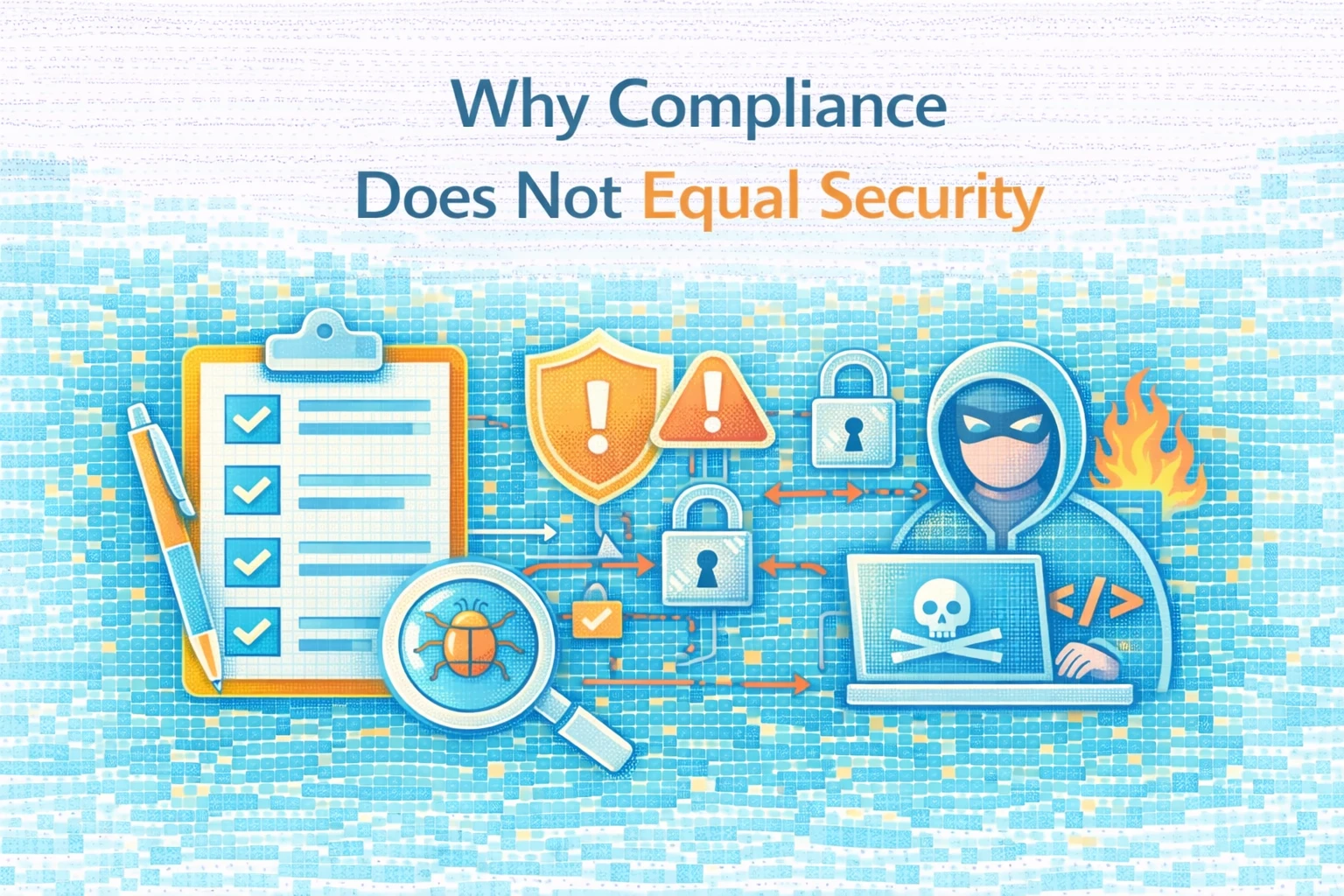
Passing a compliance checklist feels reassuring.
Boxes are checked. Reports are generated. Auditors sign off. Yet breaches continue to happen in environments that are technically “compliant.”
At Wisegigs.eu, many security incidents occur in systems that meet formal compliance requirements. The issue is not that compliance is useless. The issue is that compliance measures alignment, not real-world resilience.
This article explains why compliance does not equal security, how compliance creates false confidence, and what operational security actually requires.
1. Compliance Measures Rules, Not Reality
Compliance frameworks define what must exist, not how well it works.
Most standards focus on:
Documented controls
Policy presence
Configuration states at a point in time
Evidence of process
They do not measure:
Whether controls are enforced under pressure
Whether systems fail safely
Whether alerts are acted on quickly
Whether access paths are abused in practice
NIST explicitly distinguishes between compliance assessment and operational risk management:
https://www.nist.gov/cyberframework
A compliant system can still be fragile.
2. Compliance Is Snapshot-Based, Security Is Continuous
Audits capture a moment.
Security exists over time.
Between audits:
Configurations drift
Access accumulates
Dependencies change
New attack paths appear
Compliance rarely accounts for:
Temporary access that becomes permanent
Emergency changes left in place
New integrations added without review
CIS benchmarks emphasize that configuration drift is one of the most common causes of security failure:
https://www.cisecurity.org/controls/
Security breaks between checklists, not during them.
3. Attackers Do Not Follow Compliance Models
Compliance assumes predictable behavior.
Attackers exploit:
Misunderstood trust boundaries
Over-privileged accounts
Chained low-severity issues
Human workflows, not just systems
Real incidents rarely map cleanly to single control failures.
OWASP consistently shows that breaches result from combinations of issues, not missing checkboxes:
https://owasp.org/www-project-top-ten/
Compliance frameworks struggle to model how attacks actually unfold.
4. “Passing” Encourages Risk Blindness
Compliance success can reduce vigilance.
Once a system is labeled compliant:
Risks feel “handled”
Security investment slows
Known weaknesses are deprioritized
Teams begin optimizing for audits instead of outcomes.
This creates security theater — visible controls without practical protection.
Security research repeatedly shows that overconfidence increases breach impact:
https://www.verizon.com/business/resources/reports/dbir/
Confidence without verification is dangerous.
5. Compliance Rarely Tests Failure Modes
Security is about failure handling.
Compliance focuses on normal operation:
Correct configurations
Expected access paths
Properly followed processes
It rarely tests:
Credential compromise scenarios
Partial system failures
Alert fatigue conditions
Incident response under load
The Google SRE Book stresses that resilience depends on how systems behave when things go wrong:
https://sre.google/sre-book/handling-overload/
Security fails when failure modes are untested.
6. Access Control Looks Good on Paper
Most compliance frameworks require access controls.
In practice:
Permissions accumulate
Service accounts remain active
Former team access lingers
Temporary exceptions persist
The system remains compliant because access exists — not because it is minimal or safe.
NIST access control guidance warns that excessive privilege is a leading cause of compromise:
https://csrc.nist.gov/publications
Compliance validates existence, not appropriateness.
7. Logging Exists Without Detection
Compliance often requires logging.
It does not require:
Effective alerting
Triage processes
On-call ownership
Clear response playbooks
As a result:
Logs exist but are ignored
Alerts are noisy or absent
Incidents are discovered late
Elastic’s security research highlights that detection capability matters more than raw log volume:
https://www.elastic.co/security-labs
Logging without detection is compliance, not security.
8. Compliance Does Not Reduce Blast Radius
Security limits impact.
Compliance rarely addresses:
Isolation boundaries
Least-privilege network design
Failure containment
Lateral movement prevention
When incidents occur, compliant systems can still fail catastrophically.
AWS security architecture guidance emphasizes blast radius reduction as a core security principle:
https://aws.amazon.com/architecture/security-identity-compliance/
Containment matters more than certification.
9. Security Requires Ownership, Not Audits
Compliance assigns responsibility to processes.
Security requires ownership by people.
Without:
Clear system owners
Operational accountability
Continuous review
Incident learning loops
Controls decay.
At Wisegigs.eu, the most secure environments are not the most audited. They are the ones with clear operational ownership and continuous verification.
What Security Requires Beyond Compliance
Effective security programs share these traits:
Continuous configuration validation
Actively managed access controls
Real detection and response capability
Tested incident scenarios
Drift monitoring and correction
Clear ownership and accountability
Learning from near-misses
Compliance can support security — but it cannot replace it.
Conclusion
Compliance is not security.
It is evidence that certain rules were followed at a specific time.
To recap:
Compliance measures presence, not effectiveness
Security is continuous, audits are periodic
Attackers exploit real behavior, not models
Compliance can create false confidence
Failure modes go untested
Access accumulates silently
Logs exist without detection
Blast radius remains uncontrolled
Ownership matters more than certification
At Wisegigs.eu, secure hosting environments treat compliance as a baseline, not a guarantee.
If your systems feel “secure” because they passed an audit, that confidence is fragile.
Real security is operational, continuous, and verified every day.
Need help assessing real security risk beyond compliance checklists? Contact wisegigs.eu.