
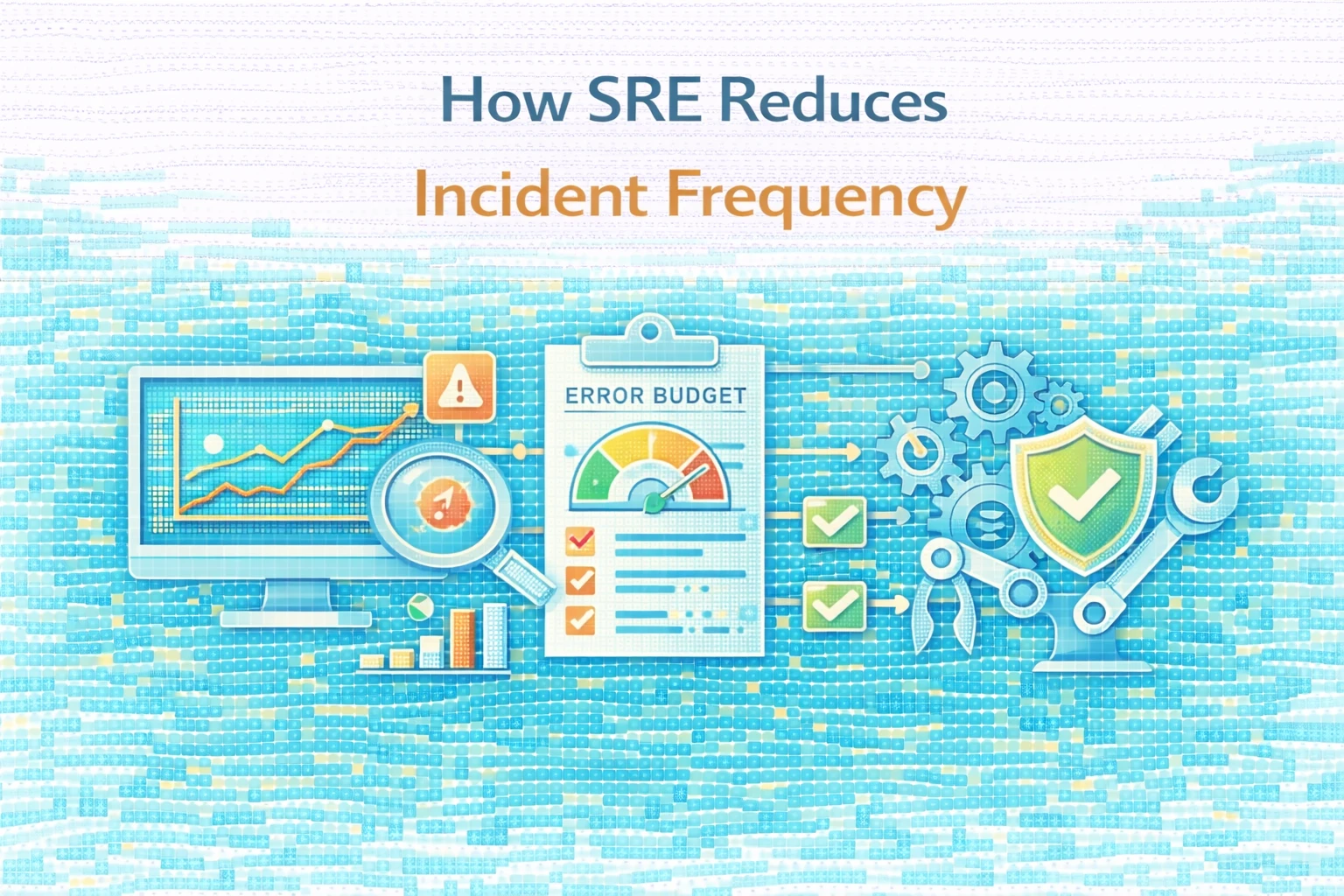
Most teams try to reduce incidents by reacting faster.
They add alerts, expand on-call rotations, and improve runbooks. While these steps help with recovery, they rarely reduce how often incidents occur in the first place.
At Wisegigs.eu, the biggest reliability gains do not come from better reaction. They come from Site Reliability Engineering (SRE) practices that prevent incidents from happening at all.
This article explains how SRE reduces incident frequency, why traditional monitoring falls short, and how prevention-focused reliability work changes system behavior over time.
1. SRE Treats Incidents as System Failures, Not Accidents
Traditional operations often treat incidents as isolated events.
Something breaks. It gets fixed. Work moves on.
SRE treats incidents differently:
Incidents reveal system weaknesses
Failures expose design limits
Repetition indicates structural problems
Instead of asking who caused the issue, SRE asks why the system allowed it to happen.
Google’s SRE Book emphasizes that incident analysis should focus on systemic causes, not individual mistakes:
https://sre.google/sre-book/postmortem-culture/
This shift alone reduces repeat incidents.
2. Error Budgets Change Incentives
One of the most effective SRE tools is the error budget.
An error budget defines how much unreliability a system can tolerate before changes must slow down.
This creates clear trade-offs:
When reliability is high, teams can ship faster
When reliability degrades, teams focus on stability
Without error budgets, teams optimize for velocity by default.
3. SRE Focuses on Leading Indicators, Not Outages
Most monitoring systems detect failure after users are affected.
SRE focuses on leading indicators:
Latency trends
Queue depth
Saturation signals
Partial error rates
These signals change before outages occur.
By acting early, teams prevent incidents instead of responding to them.
Monitoring guidance from the Google SRE Book highlights the importance of symptom-based, user-focused signals:
https://sre.google/sre-book/monitoring-distributed-systems/
Early signals reduce incident volume far more effectively than more alerts.
4. Reliability Work Targets the Biggest Failure Sources
SRE prioritizes work based on impact.
Instead of fixing random bugs, SRE teams:
Identify top incident contributors
Eliminate entire failure classes
Reduce blast radius
This includes:
Removing single points of failure
Automating fragile manual steps
Improving isolation boundaries
AWS reliability guidance consistently stresses eliminating common failure patterns over incremental fixes:
https://aws.amazon.com/builders-library/
Fewer failure modes mean fewer incidents.
5. Change Management Becomes Risk-Aware
Many incidents are change-induced.
SRE reduces incident frequency by controlling how change enters production:
Gradual rollouts
Automated rollbacks
Pre-deployment validation
Canary releases
Not all changes carry equal risk, and SRE pipelines reflect that.
Research from Google shows that most outages correlate with releases, not steady-state operation:
https://cloud.google.com/architecture/devops/devops-tech-release-strategies
Reducing risky change paths directly reduces incidents.
6. Automation Removes Repetitive Human Error
Manual processes scale poorly.
Every manual step introduces variability and error potential.
SRE focuses automation on:
Repetitive operational tasks
Recovery procedures
Configuration enforcement
By standardizing execution, SRE reduces the likelihood of mistakes under pressure.
The Google SRE Book highlights automation as a core mechanism for reliability improvement:
https://sre.google/sre-book/automation-at-google/
Fewer manual actions mean fewer accidental incidents.
7. Capacity Planning Prevents Load-Induced Failures
Many incidents occur during growth.
Traffic increases. Workloads change. Systems hit unseen limits.
SRE treats capacity as a first-class concern:
Regular load forecasting
Saturation monitoring
Headroom planning
Instead of reacting to overload, SRE teams anticipate it.
8. Postmortems Create Permanent Improvements
Postmortems are not reports.
In SRE, they are engineering inputs.
Effective postmortems:
Identify systemic contributors
Produce concrete follow-up actions
Track fixes to completion
Over time, the system becomes harder to break.
This compounding effect is one of the strongest reasons SRE reduces incident frequency.
At Wisegigs.eu, teams that consistently close postmortem action items see measurable incident reduction within months.
9. Reliability Becomes a Shared Responsibility
SRE distributes responsibility for reliability.
Developers:
Own how code behaves in production
Operations:
Own system behavior and signals
Product:
Understand reliability trade-offs
When reliability is shared, risky decisions decrease.
What Reducing Incident Frequency Actually Requires
SRE-driven reliability programs focus on:
Systemic failure analysis
Error budgets tied to user experience
Leading indicators over outages
Eliminating entire failure classes
Risk-aware change management
Automation of repetitive work
Proactive capacity planning
Actionable postmortems
Shared ownership
Reliability improves when prevention becomes the goal.
Conclusion
SRE reduces incident frequency by changing how systems are built and operated.
To recap:
Incidents are treated as system failures
Error budgets balance speed and stability
Early signals prevent outages
Failure classes are eliminated
Risky changes are controlled
Automation removes human error
Capacity is planned, not guessed
Postmortems drive real fixes
Reliability is shared
At Wisegigs.eu, teams that adopt SRE principles see fewer incidents not because they react faster, but because there is less to react to.
If your incident count keeps rising despite better alerts and faster response, the missing piece is usually prevention.
Want help applying SRE practices to reduce incidents in your hosting environment? Contact wisegigs.eu.