
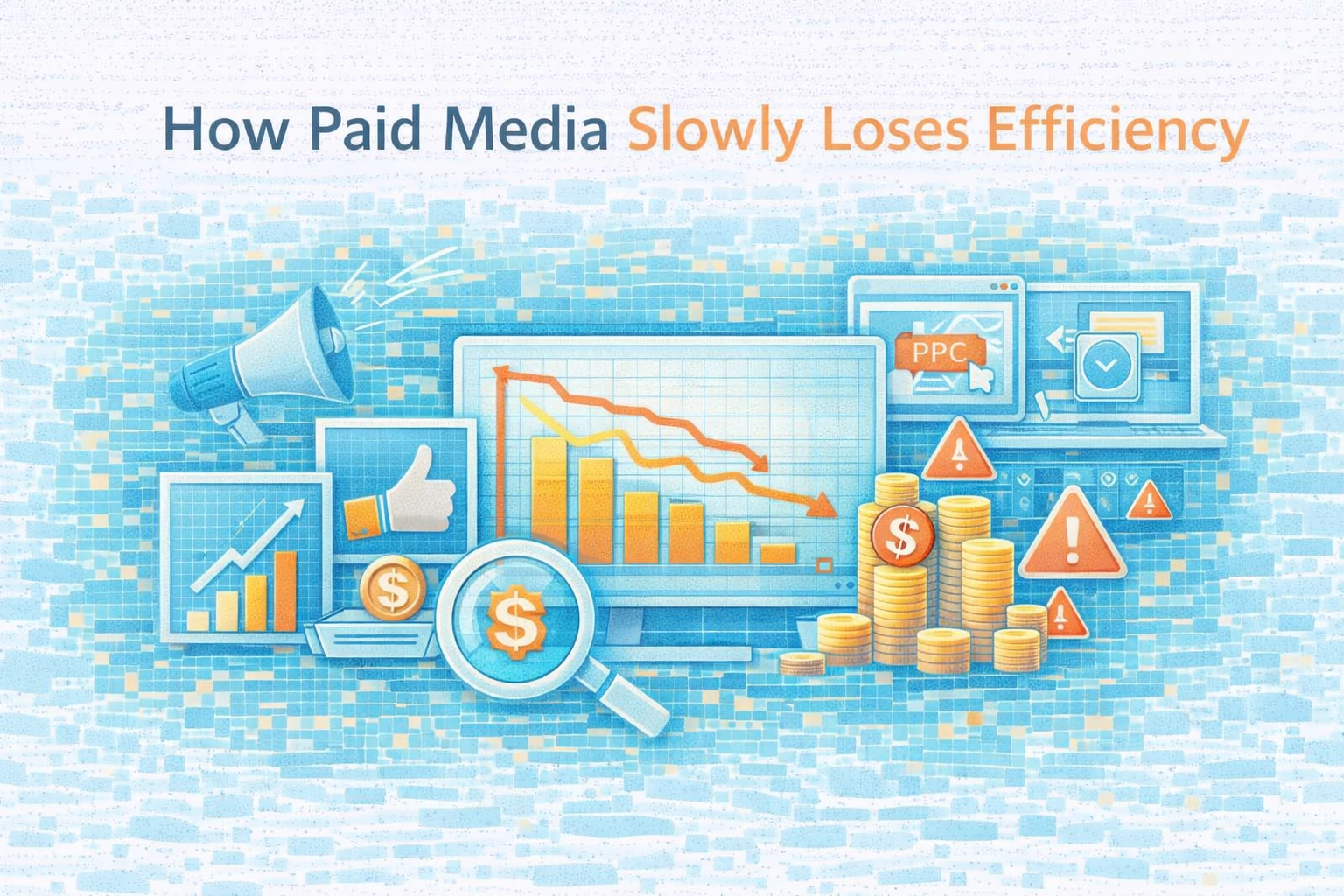
Paid media rarely fails suddenly.
Campaigns keep running. Clicks keep coming. Dashboards look stable. Yet over time, costs rise, returns shrink, and teams struggle to explain why performance no longer matches past results.
At Wisegigs.eu, declining paid media efficiency is almost never caused by a single bad decision. It is caused by structural decay — small, compounding issues that quietly erode performance while metrics still appear acceptable.
This article explains how paid media slowly loses efficiency, why the decline often goes unnoticed, and what disciplined teams do to prevent it.
1. Audience Saturation Sets In Quietly
Most paid media strategies rely on a finite audience.
At first, campaigns reach high-intent users. Over time, frequency increases and saturation follows.
Common symptoms include:
Rising cost per click
Stable impressions but declining engagement
Repeated exposure to the same users
Performance drops not because targeting is broken, but because the same users are being shown the same messages too often.
Meta’s ad delivery documentation confirms that frequency saturation directly impacts engagement and efficiency:
https://www.facebook.com/business/help
Without active audience expansion or creative rotation, efficiency erodes naturally.
2. Creative Fatigue Reduces Incremental Impact
Creative assets have a lifespan.
Even strong ads lose effectiveness as users become familiar with them.
Typical signs include:
Declining click-through rates
Flat conversion rates despite stable traffic
Increased spend required to maintain volume
Because platforms continue delivering impressions, the decay feels gradual.
Google Ads guidance highlights creative freshness as a key factor in sustained performance:
https://support.google.com/google-ads/answer/6163740
Paid media efficiency declines when creative renewal lags behind spend growth.
3. Platform Optimization Shifts Away From Business Goals
Paid media platforms optimize toward what they can measure easily.
Clicks. Views. Engagement signals.
If conversion tracking is incomplete or delayed, platforms optimize toward proxy metrics instead of outcomes.
Over time, this causes:
Traffic quality drift
Higher volumes of low-intent users
Lower downstream conversion efficiency
Google’s conversion tracking documentation makes it clear that optimization quality depends on signal accuracy:
https://support.google.com/google-ads/answer/6095821
When signals degrade, platform optimization follows them in the wrong direction.
4. Attribution Masks Real Performance Decline
Attribution models smooth performance changes.
This is useful — and dangerous.
As efficiency drops:
Assisted conversions hide declining direct impact
Last-click models over-credit branded or retargeting traffic
Incrementality loss goes unnoticed
As a result, campaigns appear stable even as true value declines.
Attribution research from the IAB emphasizes that attribution models often lag real performance changes:
https://www.iab.com/guidelines/
Paid media efficiency erodes fastest when attribution is treated as truth instead of approximation.
5. Incrementality Is Assumed, Not Measured
Many paid media programs assume all conversions are incremental.
In reality:
Some users would convert without ads
Retargeting captures existing intent
Brand demand absorbs budget
As spend increases, incremental value decreases.
This creates the illusion of scaling while ROI shrinks.
Harvard Business Review research on advertising effectiveness shows that marginal returns decline as exposure increases:
https://hbr.org/
Efficiency drops when incrementality is not tested or challenged.
6. Budget Growth Outpaces System Maturity
Paid media often scales faster than supporting systems.
Budgets increase before:
Tracking improves
Landing pages mature
Conversion paths are optimized
Data quality stabilizes
As a result, more spend flows through the same friction.
At Wisegigs.eu, we frequently see paid media budgets double while conversion infrastructure stays unchanged. Efficiency drops, but spend continues.
Scaling spend without scaling systems accelerates inefficiency.
7. Optimization Focuses on Local Metrics
Paid media optimization often targets local improvements.
Examples include:
Lower CPC
Higher CTR
Cheaper CPM
These improvements do not guarantee better outcomes.
Optimizing local metrics can reduce overall efficiency when it attracts lower-quality traffic.
Google’s analytics documentation emphasizes aligning optimization metrics with business goals, not surface-level indicators:
https://support.google.com/analytics/answer/10089681
Efficiency declines when optimization targets the wrong constraint.
8. Data Quality Degrades Over Time
Tracking environments change.
Privacy updates, browser restrictions, consent frameworks, and tag changes all affect data quality.
Over time:
Conversions become underreported
Signals fragment across platforms
Optimization algorithms receive weaker feedback
As signal quality drops, paid media platforms make worse decisions.
This degradation is gradual, making it easy to overlook.
Industry analysis from Mozilla highlights the long-term impact of privacy changes on advertising measurement:
https://blog.mozilla.org/
Efficiency declines when signal integrity erodes.
9. Teams Normalize Declining Performance
Perhaps the most dangerous phase is normalization.
Rising costs are accepted as “market conditions.”
Lower ROI is blamed on competition.
Benchmarks quietly reset downward.
Once this happens, decline becomes invisible.
At Wisegigs.eu, reversing paid media inefficiency often starts by questioning assumptions teams stopped challenging.
How to Prevent Paid Media Efficiency Decay
Sustainable paid media programs share common practices:
Actively manage audience saturation
Rotate and refresh creative intentionally
Protect signal quality and tracking accuracy
Challenge attribution assumptions
Test incrementality regularly
Scale systems before scaling spend
Optimize for outcomes, not surface metrics
Paid media efficiency requires continuous calibration, not constant spending.
Conclusion
Paid media rarely stops working.
It slowly becomes less effective.
To recap:
Audience saturation reduces returns
Creative fatigue erodes engagement
Platform optimization drifts without strong signals
Attribution hides decline
Incrementality shrinks over time
Spend grows faster than systems
Local optimization misleads
Data quality degrades
Decline becomes normalized
At Wisegigs.eu, paid media performance improves when teams treat efficiency as a system property, not a campaign setting.
If your paid media costs keep rising while results feel flat, the issue is rarely the platform.
It is how efficiency is managed over time.
Need help diagnosing where your paid media efficiency is leaking? Contact wisegigs.eu.