
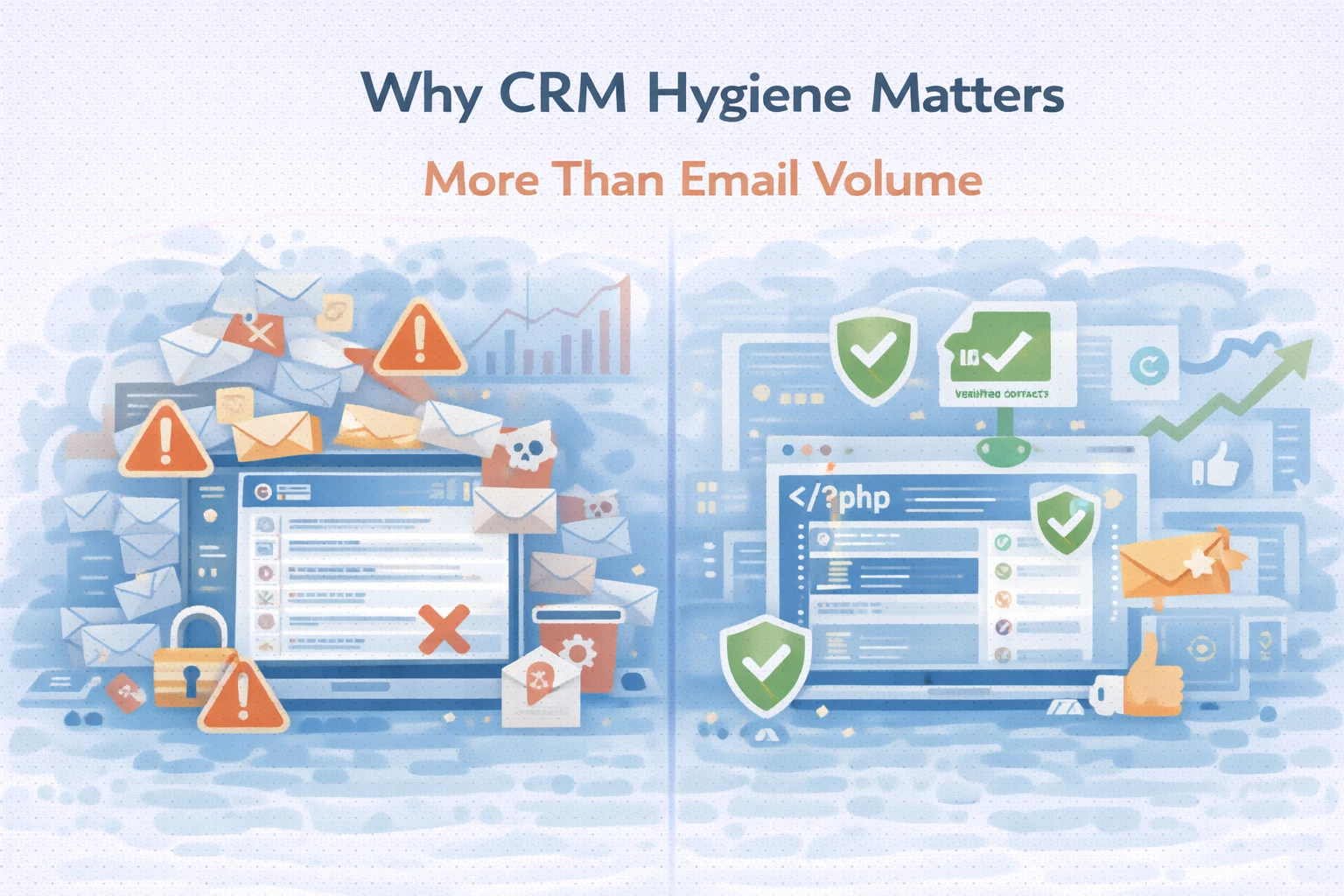
Email marketing rarely fails because teams send too few emails.
It fails because they send emails to the wrong data.
At first, the system works. Lists grow. Automations fire. Campaigns perform “well enough.” Over time, however, open rates soften, conversions decline, deliverability becomes inconsistent, and teams respond by increasing volume.
That response makes things worse.
At Wisegigs.eu, many email and CRM problems trace back to a single root cause: poor CRM hygiene quietly corrupts the system until volume becomes a liability instead of a lever.
This article explains why CRM hygiene matters more than email volume, how data decays over time, and how clean systems outperform aggressive sending.
1. CRM Data Decays by Default
CRM data does not stay accurate on its own.
Even in well-maintained systems, data degrades due to:
Job changes
Role changes
Company closures
Email provider filtering
Temporary sign-ups with low intent
Duplicate or merged records
Every CRM accumulates outdated, incomplete, or misleading data over time.
This is not a tooling problem. It is a natural property of user data.
When teams ignore decay, every campaign inherits the problem.
2. Email Volume Amplifies Bad Data
Email volume does not fix weak data.
It amplifies it.
When CRM hygiene slips:
Low-intent contacts receive more messages
Inactive subscribers trigger engagement penalties
Invalid or recycled addresses increase bounce rates
Spam complaints rise slowly, then suddenly
Each send teaches inbox providers something about your domain.
More volume means more signals — good or bad.
If the underlying data is weak, volume accelerates reputation damage.
3. Deliverability Problems Start in the CRM, Not the ESP
Many teams diagnose deliverability issues at the email platform level.
They tweak:
Subject lines
Send times
HTML structure
Authentication settings
These changes help at the margins.
However, inbox placement is driven primarily by recipient behavior, not creative quality.
Poor CRM hygiene leads to:
Low opens from disengaged users
Deletes without reading
Ignored messages
Spam complaints from users who forgot they opted in
Inbox providers interpret this behavior as a signal that your emails are unwanted.
No amount of clever copy offsets bad engagement signals at scale.
4. Automation Makes Hygiene Problems Harder to See
Automation hides decay.
Once flows are live:
Welcome sequences keep sending
Re-engagement campaigns trigger automatically
Lifecycle emails fire based on stale attributes
Because automation is always running, performance degradation appears gradual.
Teams notice:
Slightly lower CTR
Marginally worse conversions
Increasing reliance on promotions
Nothing breaks visibly. The system just becomes less effective.
At Wisegigs.eu, we often see CRM systems where automations have been running for years without validation — quietly accumulating outdated logic and polluted segments.
5. CRM Hygiene Directly Affects Revenue Attribution
Dirty CRM data does more than hurt email performance.
It corrupts measurement.
Common effects include:
Inaccurate lifecycle stage tracking
Inflated lead counts
Misattributed revenue
Broken segmentation
When attribution relies on bad data, teams optimize the wrong things.
Email volume can increase activity metrics while masking declining revenue quality.
6. List Growth Without Hygiene Creates Long-Term Risk
Many teams prioritize list growth as a primary KPI.
Without hygiene controls, this creates hidden risk:
Lead magnets attract low-intent signups
Contests introduce one-time participants
Imported lists degrade trust signals
Inactive users linger indefinitely
The list grows. Performance declines.
Eventually, inbox providers stop trusting the sender altogether.
The irony is that larger lists often perform worse when hygiene is ignored.
7. What CRM Hygiene Actually Means in Practice
CRM hygiene is not a one-time cleanup.
It is an ongoing operational process.
Effective hygiene includes:
Regular suppression of inactive contacts
Validation of email addresses at entry points
Clear lifecycle stage definitions
Automated cleanup rules
Periodic review of automation logic
Alignment between CRM data and real behavior
This mirrors broader data governance practices described in data engineering literature, such as those outlined by Monte Carlo Data:
https://www.montecarlodata.com/blog-data-quality/
Clean systems outperform aggressive systems every time.
8. Why Fewer Emails Often Perform Better
When CRM hygiene is strong:
Engagement signals improve
Deliverability stabilizes
Conversion rates increase
Attribution becomes reliable
At that point, teams can safely scale volume.
Until then, restraint is a competitive advantage.
At Wisegigs.eu, we regularly see performance improve after reducing send volume, once hygiene controls are applied.
Email works best when it is selective, not aggressive.
How to Prioritize CRM Hygiene Over Volume
Reliable teams follow a simple order of operations:
Validate and clean CRM data
Define clear engagement thresholds
Suppress or sunset inactive records
Audit automations quarterly
Increase volume only after engagement stabilizes
Email and CRM performance is a system outcome — not a sending tactic.
Conclusion
Email marketing does not fail because teams send too little.
It fails because they send too much to data they no longer understand.
To recap:
CRM data decays naturally
Volume amplifies bad signals
Deliverability starts with engagement quality
Automation hides hygiene problems
Dirty data corrupts attribution
List growth without hygiene creates risk
Clean systems outperform aggressive ones
At Wisegigs.eu, email and CRM systems are treated as long-lived infrastructure, not campaign tools.
If email performance feels harder every quarter, the problem is rarely content or frequency. It is usually hygiene.
Need help auditing CRM health before deliverability or revenue suffers? Contact Wisegigs.eu.