
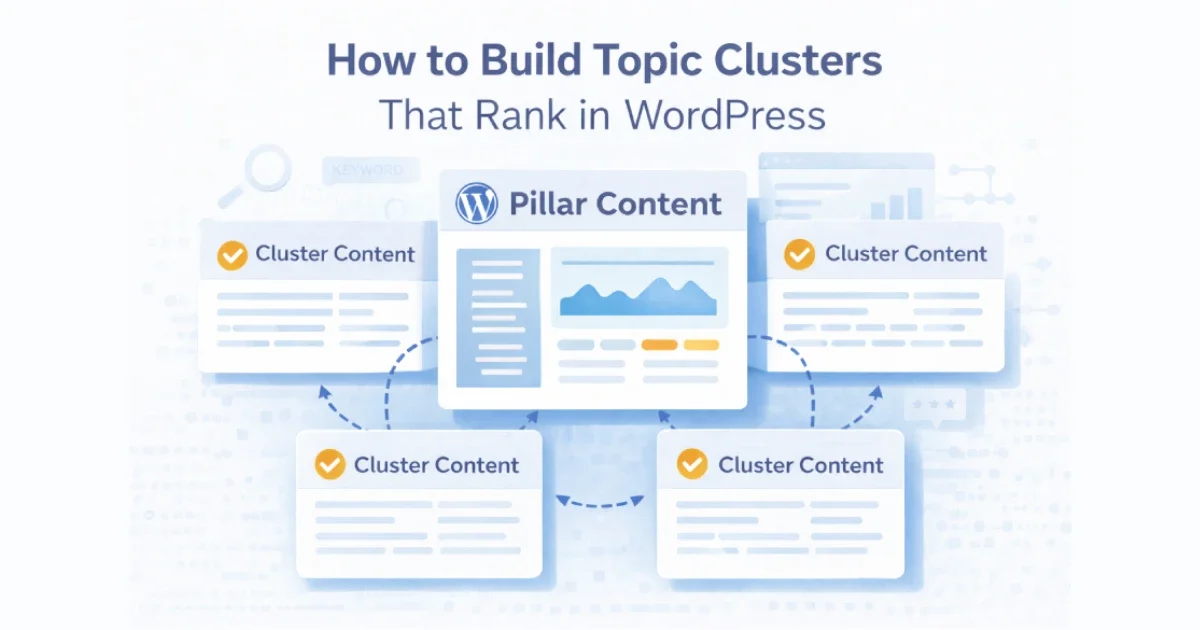
Ranking in modern search engines is no longer about publishing isolated blog posts. Google evaluates topical authority, internal structure, and how well your content ecosystem answers a full range of user intents. Topic clusters are one of the most reliable frameworks for achieving this — especially on WordPress, where internal linking and content organization can be engineered deliberately.
At Wisegigs.eu, we use topic clusters to turn WordPress sites into long-term SEO assets rather than collections of disconnected posts. This guide explains how to build topic clusters that rank consistently, scale cleanly, and survive algorithm updates.
1. What Topic Clusters Actually Are
A topic cluster is a content architecture, not just a keyword strategy.
Core components:
Pillar page – covers a broad topic comprehensively
Cluster content – supports the pillar with focused subtopics
Internal links – connect clusters bidirectionally
Clear URL and category structure
Instead of competing pages targeting similar keywords, topic clusters consolidate authority around a central theme.
Google Search Central confirms that well-structured internal linking helps search engines understand topical relationships:
https://developers.google.com/search/docs/fundamentals/seo-starter-guide
2. Why Topic Clusters Outperform Traditional Blogging
Traditional blogging often creates SEO problems:
Common issues:
Keyword cannibalization
Thin content spread across many URLs
Weak internal linking
No clear topical focus
Topic clusters fix this by:
Concentrating authority on pillar pages
Improving crawl efficiency
Creating semantic relevance
Supporting long-tail rankings naturally
Making internal linking intentional
At Wisegigs.eu, cluster-based sites consistently outperform “random blog” strategies within 3–6 months.
3. Choose Topics Based on Search Intent, Not Just Keywords
The biggest mistake is clustering around keywords instead of user intent.
Start with intent categories:
Informational (“how to”, “what is”)
Commercial investigation (“best”, “compare”)
Transactional (“pricing”, “services”)
Each cluster should map to:
One primary intent
Multiple supporting intents
Ahrefs highlights that content aligned with intent ranks more consistently than keyword-stuffed pages:
https://ahrefs.com/blog/search-intent/
4. Design the Pillar Page Correctly
Your pillar page is the authority hub.
Pillar page characteristics:
Broad topic coverage
Clear H1–H3 structure
Links to every cluster page
High editorial quality
Updated regularly
What a pillar page is not:
A thin category archive
A list of blog excerpts
A keyword dump
Example pillar topics:
WordPress Performance Optimization
Technical SEO for WordPress
WooCommerce Scaling
WordPress Security Fundamentals
5. Create Cluster Content With Clear Scope
Each cluster page should answer one focused question.
Cluster content rules:
One primary keyword
One primary intent
No overlap with other cluster pages
Links back to the pillar
Links to relevant sibling clusters
Examples:
Pillar: WordPress Performance
Clusters:
Reduce TTFB in WordPress
Redis Object Caching Explained
Core Web Vitals Optimization
Caching Pitfalls in WordPress
This structure avoids internal competition.
6. Engineer Internal Linking (This Is Where Rankings Happen)
Internal linking is the backbone of topic clusters.
Required linking pattern:
Pillar → every cluster
Cluster → pillar
Cluster → related clusters (where logical)
Best practices:
Use descriptive anchor text
Avoid generic anchors (“click here”)
Place links contextually, not in footers only
Keep link depth shallow
Moz emphasizes that strategic internal linking distributes authority and improves rankings:
https://moz.com/learn/seo/internal-link
7. Organize WordPress Categories & URLs Properly
WordPress structure should support clusters, not fight them.
Recommended setup:
One category per pillar topic
Clean, short URLs
Avoid unnecessary tag bloat
Use breadcrumbs where possible
Bad structure causes:
Duplicate URLs
Crawl inefficiency
Diluted topical signals
Smashing Magazine notes that clean information architecture improves both UX and SEO performance:
https://www.smashingmagazine.com/
8. Update and Expand Clusters Over Time
Topic clusters are living systems.
Ongoing optimization:
Add new cluster pages as questions emerge
Expand pillar pages quarterly
Merge or prune underperforming clusters
Update internal links as content grows
Evergreen clusters compound value over time.
9. Measure Topic Cluster Performance Correctly
Do not evaluate clusters by single-page rankings alone.
Better metrics:
Total organic traffic to the cluster
Number of ranking keywords per cluster
Average ranking position across the topic
Internal click flow
Assisted conversions
Google Search Console and GA4 are ideal for cluster-level analysis.
10. Common Topic Cluster Mistakes to Avoid
- Creating multiple pillar pages for the same topic
- Letting clusters overlap in scope
- Ignoring internal links
- Publishing without intent alignment
- Treating clusters as one-time projects
Topic clusters require discipline, not volume.
Conclusion
Topic clusters are one of the most reliable ways to build sustainable SEO growth on WordPress. When done correctly, they align content with intent, consolidate authority, and make internal linking work in your favor.
To recap:
Build clusters around topics, not keywords
Design strong pillar pages
Create focused, intent-driven cluster content
Engineer internal linking deliberately
Structure WordPress categories cleanly
Measure performance at the topic level
Want to build topic clusters that actually rank? Contact Wisegigs.eu